Showing posts with label Syrah. Show all posts

Sunday, September 22, 2019

ISRAEL is WHERE IT'S AT!

Bear with me if I sound like a broken record, but you know I go nutso over wines from less-common locales, and here's another one! I have long enjoyed wines from Israel, but two recent tastings catapulted the country to the forefront of my mind; the quality is amazing, the potential is HUGE, and the value is incredible. So banish those thoughts that Israel only makes grape-juicy Kosher wines already and get with the program!

It's a little funny that in one sense Israel is absolutely "Old World" -- it's one of the very first places ancient people grew grapes. But it's certainly "New World" in guts and style.

Here are some things to keep in mind:
  • There really is no clear "signature" grape of the region. In fact, Grenache was first planted only about ten years ago and is making some of the world's best already! As knowledge, experimentation, and technology grow, so will the quality and variety of Israeli wines.
  • Many bold Israeli reds are actually super-approachable, meaning they're not overly-structured and require years of cellaring before you pop them. These are meant to be drunk now!
  • This is a group of winemakers who are forging forward, breaking conventions, and doing it all with passion and a strong intellectual and environmental basis. They are Jewish, Muslim, Christian, and non-religious to boot. 
  • There are only about 35 commercial wineries, but around 250 boutique ones, and this number is rising as grape-growers peel off to make their own wines. Some of which are already achieving "cult" status!

Here are some of my standouts from those recent tastings:

2018 Five Stones “D vs G” White (David v Goliath) 
Appellation laws are fairly relaxed in Israel, so they have a lot of options for experimentation with blends. I initially had a "hmmmmm" reaction to this 60% Gewurztraminer 40% Sauvignon Blanc blend, as who thinks to put those two grapes together?! And I did feel it kind of butted itself in the head, BUT boy how it would go with the spiced and spicy food of the region. Typical "grandma's boudoir" Gewurz notes of dusty rose perfume with litchi, accompanied by SB's green, linear acidity. Outrageously long finish. I definitely warmed up to it! ~$30

2017 Recanati Winery Reserve Marawi 
Marawi is one of the indigenous varieties of the area now getting resurrected. This was first commercially released in 2014, and is the tricky story of a Palestinian grower who sells the grapes grown in his backyard to an Israeli company. (His name isn't released because they have had death threats on both sides, yikes.) Recanati also has their own vineyards, and produce a Roussane/Marsanne blend and an old bush vine Carignan, all farmed biodynamically. This had yellow fruit, sweet brioche, juicy apricot, lanolin, honeysuckle, and a little spice with smoky, flinty minerality. Long yet mild finish. Little Chenin Blanc-like. 1 year in French oak. ~$34

2011 Somek Carignan
This is from a single vineyard with 40-year old vines. The Someks are 5th generation winemaker-grapegrowers, so this is a family vineyard since 1882; the winery itself was founded in 2002. The family does it all, including marketing and distribution. This Carignan is aged 24 months in French oak and 2 years in bottle. Definitely earthy, terroir-driven. Cola, hi-tone blueberry, mocha dust, minerally, with licorice, brambly berries, wild sage, a little spicy, and has tightly wound, balanced tannins over a super long finish. Continues to be tangy after 7 years! And it's still kind of a baby. This will be fascinating in a few more years! ~$35

2016 Hayotzer Lyrica
Arza, Hayotzer's parent company, started in 1847! Here we have a GSM blend (40% Grenache, 35% Syrah, 25% Mourvedre.) Soft red and pink flowers, crunchy red fruit, white pepper, smooth and sexy, plush but juicy, whiff of smoke on finish, not super-complex but really tasty and I wanted to slurp it uuuup. ~$40

2016 Gvaot Masada
Shiva Drori, Gvaot's winemaker, is interested in the academic side of making wine; he does DNA testing, studies wine at a high level, and brings that information back to the vineyards and winery. The Masada is a blend of 56% Cabernet Sauvignon, 22% Merlot, 22% Petit Verdot, from rocky, steep, mountainous vineyards, with a huge diurnal swing; the elevation and diurnal keep the temperature in check and preserve the grapes' freshness and acidity. At my tasting, I thought this wine glass was not properly clean, muting the wine's aroma, and so this showed merely dusty on the nose. But in the mouth there was loads of tightly wound purple fruit (that PV really jumps forward!) leading to a big and structured, but balanced wine. Wow. ~$75

2016 Covenant Syrah
Covenant brought winemaker Jeff Morgan from Napa over to consult, and that has led to its growing cult status. This wine is 90% Syrah with a dash (10%) of Cabernet Sauvignon. It presents as liquid red fruit, spicy and juicy and lush and sexy, pepper, light savory notes, super balance of fruit/savory/spice/oak use plushness, wow! Lifted tang on long finish. Chewy. It brings voluptuousness without blousy-ness. ~$75

2016 Tura “Mountain Peak” Red
Another cult comes from the husband/wife team Vered and Erez Ben Sa'adon (she's the winemaker.) The Mountain Peak red is a blend of 47% Cabernet Sauvignon, 38% Merlot, 9% Cabernet Franc, and 6% Petit Verdot. Cassis, cedar, herbal liqueur, pyrazine, good acid once again, tangy juicy outrageously long finish. This is definitely a creative take on a CS-based Bordeaux-style blend. ~$75

2016 Segal “Unfiltered” Cabernet Sauvignon
The Israeli cults just keep on coming! Winemaker Avi Feldstein has boldly produced an unfiltered Cab since the days when that was a kind of blasphemy. This is a super-interesting wine, with cassis liqueur, bright red fruit, mocha, toasted coconut, a bit of shortbread. Wow. Really “red,” dense and intense. Long finish. Big but plush/approachable. Segal is owned by the large company Barcan — "big kids" in Israel sometimes acquire or start small wineries to have a garagiste offering. ~$60

2014 Golan Heights Winery Yarden “2T” 
Golan Height is one of the coldest areas in Israel, and much like the U.S.'s Old West, there are wild horses galloping along wide volcanic plains. This is one of the country's more classic wineries, and here they're showcasing how Portuguese varieties can shine in Israel. A blend of 69%Touriga Nacional and 31% Tinta Cão sourced from 2 vineyards in Golan Heights: Springs Vineyard at 700 meters elevation, and Geshur Vineyard at 400m. Aged 18 mo in 40% new French oak. Smoky, spicy mocha, black plum, blackberry, black cherry, lots of peppery spice on finish. Good combo of juicy, approachable fruit, some more savory notes, and balanced acid and subtle tannins on long, balanced finish.  ~$33

2014 Tabor Winery Malkiya Single Vineyard CS 
Tabor was founded in 1999 by four families of growers that have working there for five generations. This Cab is from a single vineyard at 726 meters elevation with Terra Rossa (the most famous soil of Coonawarra in Australia,) under topsoil, and lots of limestone rocks they refer to as “a lot of stars.” Viticulturist Michal Ackerman found this area and she convinced them to make wine there! Her vines' roots go down 20 feet so they have access to water and unusually for Israel don’t need irrigation. She’s also planting Malbec and Chenin Blanc in the Negev desert, so watch for those.  These Cabernet Sauvignon grapes are hand picked, they use only free-run juice, and it is aged 18 months in new French oak with an additional 1 year in bottle. Smoky, cassis, cedar, cloves, wow, VERY tasty, with the red fruit coming out more on the palate. Tightly wound, and it releases layers of flavors over an incredibly long, balanced finish. Would be fun to blind taste this on some smarty somms! ~$60


#          #          #

I don't know about you, but I am definitely planning to seek out more of these amazing wines from Israel. At the high end, maybe $60-75 bucks seems like a lot, but you'd be paying $150-300 for a similar wine from Napa, so these actually are a steal! Ask your merchants and somms about providing more quality wines from Israel; they may appreciate your "insider" know-how, but they also need to know you're interested in trying these stunning offerings. (Seriously, there was hardly a dud in the bunch, and I sampled over FIFTY wines.) I look forward to my next "visit" to Israel, for sure!

Cheers.


Wednesday, November 21, 2018

WHAT TO DRINK WITH THE BIRD!

Image result for turkey and wine
image: foodandwine.com
Hi Wineaux -- I know this is last-minute, but a lot of you have been asking, so I'm putting down my study books and closing my script and ANSWERING YOUR CALL.

Thanksgiving can be a crazy time; figuring out what to drink shouldn't be. There are a few basic things to keep in mind:

1) Lots of Turkey Day food is, well, bland. Potatoes, stuffing, turkey... YAWN. Your wine should provide the PIZZAZ! However, now is not the time to pop open that super-concentrated, oak-aged, dense, intense Cab. It'll overwhelm.

2) You might love and appreciate wine, and Aunt Frieda is definitely a Wineau, but the rest of the fam? Maybe not. Look for excellent values, so when Uncle Fred puts ice cubes and a packet of Splenda in his red, you won't pass out.

3) Acid is always your friend, when it comes to food-and-wine pairing. You might not first think of red wines with turkey, but a high-acid red... PERFECTION.

Let's get to it! (PS all of this goes for the rest of your holiday dinners as well!!)

ALWAYS A WINNER: Champagne
Yes, this might violate guideline #2, but substitute a good-value sparkling wine made in the Champagne method and you're good to go.
Image result for taittingerWHY? Bubbles! Festive! And its acidity and rich toasty nutty flavors will pair perfectly.
Value -- Lucien Albrecht Crèmant d'Alsace ~$17, Gruet Blanc de Noirs (NM) ~$14 Louis Boillot Crèmant de Bourgogne Rosé ~$20.
Mid-price -- Taittinger Brut La Francaise Champagne ~$38, Moet & Chandon Brut Imperial Champagne ~$38.
Splurge -- Krug Grande Cuvée Champagne ~$160,  Billecart-Salmon Brut Rosé Champagne ~$75.
Image result for ca montanari lambrusco

DARK HORSE: Lambrusco
Skip the sweeter inexpensive versions and head straight for this herby, dark-fruited Italian bubbly.
WHY: Also bubbles! Rich earthiness and plum/blackberry fruits are lifted by its freshness.
Ca Montanari Opera 02 Lambrusco ~$17, Zanassi La Grasparossa Lambrusco ~$13.


FRESH AND FRUITY: Beaujolais
If you're tempted to throw a Beaujolais Nouveau in your cart, I won't stop you. But the mass-market ones are so ephemeral, you'll miss the gloriousness of what a Beaujolais with some oomph and character can give. If you do want in on the fun, ask for a smaller, recommended producer. Non-Nouveau is a different story! And named crus (named regions, like Morgon below,) will cost a bit more, but will definitely deliver, so a splurge here is worth it!
WHY: Gamay (the grape) is bright, fruity, and fresh. Flirty personality, and smooth sailing. And most are under $20-25.
Value -- Ch. du Basty Lantignié Beaujolais ~$12, Pierre-Marie Chermette Beaujolais ~$14
Splurge -- Marcel Lapierre Morgon Beaujolais ~$40


ALSO
A lighter-style Shiraz/Syrah shpicy crowdpleaser like Charles Smith Boom Boom Syrah (WA) ~$13 (I'm bringing this to our company's TGiving!)
2016 J. Lohr Chardonnay Riverstone 750MLHeavy-duty but real fruity oak-influenced Chardonnay like J. Lohr Riverstone Chardonnay (CA) ~$11 (This has been my dad's "house wine" for decades!)
A white with savory elements like a dry Furmint (Hungary) like Evolúció Tokaji Furmint ~$12 (I am obsessed with dry Tokaji!)
Or a Grüner Veltliner (Austria) with its white pepper/celery character, yet often with yummy stone fruit like the Weszeli Langelois ~$17
I'm also a sucker for a delish Sangiovese: Villa Sant'Anna Chianti Colli Senesi ~$19 or Antinori Santa Christina Chianti Superiore ~$13. Other Sangiovese wines are Rosso di Montalcino ($20-30 range,) and Brunello di Montalcino if you want to get a bit more splurgy, ask for good (and good-value) producers from your purveyors.
Other high-acid reds to look for: Pinot Noir from all around the globe, Zweigelt, Blaufrankish.

As always, many of these may not be available in your local wine shop; bring this list with you and ask for comparable suggestions! Your wine merchant should be your new best friend, always. This is just the tip of the iceberg; there are so many suggestions, you really can't go wrong... let me know what you paired with YOUR bird!!

Cheers.

Sunday, October 5, 2014

WINES OF CHILE—INVIGORATING!

Fact: Chile is a long and skinny country in South America that has cultivated wine since the Spanish Conquistadores arrived in the 1500s. Fact: Chile is one of the only places in the world where the devastating root louse Phylloxera failed to take purchase, so vines there are planted on their own roots. Fact: Carmenere in the vineyards there was long mistaken for Merlot, so it flourished in Chile while nearly becoming extinct elsewhere. 

All pretty substantial facts, where the world of wine is concerned, yes?

But also: Chile hasn't really been known for making quality wine until a few decades ago, so with relatively speedy advances in winemaking techniques and passed-along knowledge, there has been a kind of "secret" major growth in the Chilean wine industry. Wineaux, we can keep this secret no longer!
At a recent tasting of Chilean wines led by the always-engaging Fred Dexheimer, MS, and Hector Vergara, MS (South America's only Master Sommelier,) it became evident that the current generation of Chilean winemakers are infusing their industry with a fresh, invigorating breath. Experimentation and rule-breaking are the buzzwords, and the results are delicious. Not to mention, there are diverse styles of grapes—something for everyone—and the general price point is unbelievable for the quality. (Starred entries are particular favorites.)

*2013 Caliterra Tributo:100% Sauvignon Blanc from the coastal Leyda Valley. Pale straw gold color, fresh nose of kiwi and gooseberry, lemon-lime, papaya and lime curd. Well-balanced fruit and acidity, grass and fresh herbs emerge on the long finish, mid-palate minerality, a bit of kelp/seaweed, quaffable but complex. ~$15

2012 Casa Silva Sauvignon Gris: from over 100-year-old vines in Colchagua Valley, was thought to be Sauv. Blanc until 1998 when they discovered it was actually Sauv. Gris. Pale straw color, über-minerally, herbaceous, "hot" lemon, not overly acidic but it clings to the teeth, white pear and peach on the clean finish. ~$18

2011 Tamaya Chardonnay T Line Limited Release: Limari Valley. Pale gold, pineapple and cream, bit merde-y, warm apple pie. In the mouth, white florals, lime zest, chalky minerals, integrated use of oak. ~$15

2012 Clos des Fous Subsollum Pinot Noir: Aconcagua Coast/Pucalan/Traiguen Valley. The winemakers are four "crazy guys" who are seeking out unusual terrors and pushing boundaries. Fred said, "They don't care what anyone thinks about their wines," which I believe is often a good thing! And Hector opined, "It's a beautiful example of what's new in Chile. Wines with minerality—wines breaking barriers." Pale garnet/ruby. Underripe berries, very spicy, rose petal potpourri, stemmy bramble fruit nose. Very spicy in the mouth too! Tart cranberry, pepper/cinnamon, sour cherry, minerality, fairly tannic, decent acidity, very interesting. ~$22

*2009 Oveja Negra Carignan Single Vineyard: Maule Valley. Mostly Carignan though somewhat of a field blend, with Petit Verdot as a backbone. Medium ruby, warm, velvety nose of cherry liqueur. Elegant, fresh cherry/berry notes, warmth and integration on the finish, bit of licorice/bark, good acidity, integrated tannins. Very nice! ~$20

2011 De Martino Vigno Carignan: Maule Valley. In terms of experimentation, this winery is the first Chilean operation to buy large Austrian oak barrels, and they're working with concrete eggs and modern amphorae vessels as well. Medium ruby color. Pizza (!) nose—oregano, tomato, dough—and meaty with a high tone of perfume. Cherry jam, spice, earthy. The acidity lifts it up; I wasn't initially a fan, but this one grew on me and I kept returning to it. ~$35

*2012 MontGras Antu by Ninquén Syrah: Colchagua Valley. Medium ruby. Interesting nose of lilac, violets, pepper, blackberries, clove, licorice, and a bit of oak. Lightly spicy in the mouth, but it lingers. Less-ripe fruit on palate, but rich, long, integrated finish. Herby, juicy, touch of vanilla, touch of chocolate, very nice (I even drew a heart.) ~$12

2013 Viña Ventisquero Grey GCM: Colchagua/Apalta Valley. A bit of a takeoff on the GSM (Grenache, Syrah, Mourvedre) blends of the Rhône and Australia, this Grenache, Carignan, Mataro (aka Mourvedre) is a medium ruby, with a very clean and laser-like nose of red fruit, whiff of merde, and floral perfume. In the mouth, raspberry prevails, with cherry and savory notes of bay leaf, cinnamon, black pepper, and eucalyptus. Good acidity, soft but grippy tannins, this is really interesting. Fred calls these guys "thrill-seeking winemakers." ~$20

*2011 Odfjell Vineyards Orzada Malbec: Curico/Lontué Valley. Medium-plus ruby. Interesting nose! Liquid herbs, rosemary, sweet basil, with black cherry, violets, and smoke. Surprisingly lighter in mouth after such a powerful nose, with blueberries, spicy cigar leaf, iodine. Elegant with good tannins and lifted by acidity. Yum. ~$18

*2010 Concha y Toro Terrunyo Block 27 Carmenere: Cachaopal Valley. From one of the Chilean names you may recognize, the Carmenere from the "perfect storm" Peumo Vineyard has a medium-plus ruby color, and a nose of burnt cinnamon spices, graphite, coriander, and wood. In the mouth, plums, graphite and ashes, and very integrated tannins and subtle acidity make for a long, smooth finish. ~$38

One of my favorites was the *2011 Montes Purple Angel: Colchagua (Apalta/Marchigue) Valley. 92% Carmenere, 8% Petit Verdot. Opaque ruby color. Nose of mocha powder, lavender, ripe blue and black fruits. Incredibly dense in the mouth; cedar, "sweet" spices, fresh herbs, blackberry liqueur, bit of graphite/iodine. Very complex and lush, big but balanced, some acidity and sweet tannins. ~$75 (I was so hoping it was $12.99, but no dice!)

2010 Santa Rita Triple C: Maipo Valley. If you're looking for something "Evocative of Bordeaux with more fruit and spice," (says Fred,) look no further! 55% Cab Franc, 30% Cab Sauvignon, 15% Carmenere. Medium-plus garnet, nose of cranberry, bright green pepper, rose and violets, graphite, tobacco, cedar, tea leaves. In the mouth, fresh berry salad, very spicy, peppery, eucalyptus, cigar box, with subtle tannins. Certainly age-worthy. ~$43

*2010 Undurragua Altazor: Maipo Valley. From an "old" winery, this is a "new" wine; a Bordeaux-style blend, inspired by Vincente Huidobo, the author of the poem "Altazor." (80% Cab Sauvignon, 8% Carmenere, 8% Syrah, 4% Petit Verdot.) Medium-plus garnet. Harmonious nose of cherry liqueur, lots of lush, ripe red berries, cassis, smoke and spice, lots of cigar box, cedar, violets, cola, dried figs. Really elegantly woven together, dense and lush, very long, nuanced and harmonious (that is definitely the word for this wine,) finish. Velvety tannins. Oak not overly prominent, seamlessly integrated. Just WOW. I have to give it another star: * ~$70

With such diversity, it is really worth giving Chile the due it deserves. These wines were inspiring, and really spoke to the focused attention from their winemakers, especially where microclimates are concerned. And with so many quality wines under $20, you can afford to try a variety of Chilean wines yourselves. It's a no-brainer: when you need some invigoration, simply turn to Chile! Cheers.


Tuesday, September 2, 2014

SCHOLIUM PROJECT: BARREL TASTING 2014

Being a fan of the Scholium Project is a little like being in a quasi-exclusive club run by a mad scientist. I first heard of Abe Schoener and his outside-of-the-box winemaking in a 2013 article in the New York Times Magazine (read it here,) and was instantly intrigued. I got on the mailing list and tasted Scholium wines for myself four months later. Were these wines unconventional? Absolutely. Interesting? Yup. Fascinating, even? You bet.

I ordered a mixed case immediately, have added periodically to my Scholium stash, and believe me when I say it is a tough challenge to NOT open a new bottle every day, especially when fighting the fatigue of "oh, another Pinot, oh, another Chard, oh, another Cab."

Ferry view of lower Manhattan.
Members of the Scholium "fan club" will do almost anything to get a taste of what Abe has been working on, including trek out to Red Hook, Brooklyn, in a locale far—so very far—from public transportation. I myself took the Ikea ferry from lower Manhattan on a recent beautiful Sunday to participate in the latest "sneak peek" of Scholium Project wines.

The first wine was a 100% Verdelho 2013 Gemella Lost Slough Vineyard. There was only one barrel made (= 24 cases.) A lovely wine. Nose of soapstone, white flowers, a little merde-y, very perfumey aromatics. Spicy in the mouth with a lot of minerality and a long finish, yet not overly acidic. "This is made from grapes that have had the $h!t stomped out of them," said Abe. $45.

A bittersweet moment comes with the 2013 Glos McDowell Vineyards (Sauvignon Blanc.) This vintage was the final harvest from this parcel, unfortunately, as the owners of the land then ripped up the Sauv Blanc vines to plant more popular/profitable Cabernet Sauvignon. Fans of Glos quickly snapped up all of the individual bottles, regular and large-format. With a very pale gold color and a fresh, clean nose of green grass and lime zest, it showed loads of floral perfume with a little gooseberry, and a long charming, elegant finish. "It has the promise of nobility," said Abe, as he spoke bittersweetly about this last-ever bottling. $70

In case you haven't caught whiff of it, Abe's organization is somewhat akin to a pop-up shop. He doesn't own the vineyards he farms, and has a very small, hands-on production operation without a formal tasting room/sales area/oeno-tourism bent. The wines are not always labeled varietally, and there are layers of proprietary names, pulled from colleagues and/or ancient history. He gets fans from word-of-mouth; you have to find him. Production is very low, and loyal followers pounce on each new release, so one must act quickly. Occasionally he will offer single bottles, but usually the only way to ensure snagging these wines is to purchase a mixed-case offering via the website here.

Luckily there is available stock of the 2013 Dulcissima Camilla Farina Vineyards (barrel fermented Sauvignon Blanc,) because I just loved it. My notes say, "Ooooh! nose" of bruised yellow apple, overripe melon and a whiff of sherry-like oxidation. Incredibly complex in the mouth, with ripe fruit, spice, a dried nuttiness, and a looooooong finish. It felt "hot" (high in alcohol) to me, but Abe said the alcohol was relatively low, and that its zingy acidity might be contributing to the presence in the mouth. "This wine is... well, still fermenting," says Abe, explaining that it may not taste the same after bottling! But it's definitely worth a gamble, in my opinion. $45

Rather intriguing was the 2012 Michael Faraday Michael Mara Vineyard 100% Chardonnay. Nose of honeysuckle, Asian spice and pear. Bit cheeky-oddball in the mouth with yellow apple and very spry acidity. Doesn't exhibit "traditional" CA Chard notes at all, and is also slightly tannic. $80

Another fave was the 2013 The Prince in His Caves, made from barrel-fermented whole-cluster fermented Sauvignon Blanc. The color was noticeably darker, a coppery-gold. Nose of ripe apricot, melon, gardenia (notes say, "all ripe & bruised!") Each sniff results in another layer of elements, like a bit of dusty earth, then orange marmalade, then ginger. Very dry/acidic and tannins are present. "This is the wine the Scholium Project is best known for," said Abe, noting they've made this since 2006. You Wineaux know I love "strange" wines, and this is an iconic weirdo-wine; the nose is atypical Sauv Blanc and the mouth experience is very different. I am hooked. $45

The nose of the 2013 FTPZ Kirschenmann Ranch (100% Old Vine Zinfandel) was intoxicating; high tone blueberry, violets, sweet licorice, grounded by a bit o' something funky and meaty. Black cherry liqueur in the mouth. High but appropriate acidity, nice and bright, spicy, lovely, long finish, dried leaf-y element. Whole-cluster fermentation (like The Prince above.) $50

I would probably never have correctly blind-tasted the 2013 Poloupous Antle Vineyard as old-vine Pinot Noir, but that's what it is! Violet, blackberry, bit of funk, bit of rosemary and herbs. It was kind of similar in style to the FTPZ, actually, although more tannic, smoother, and less bright fruit. I look forward to seeing how this evolves and integrates over time. The prominent tannins were what threw me, but Abe said, "That is a very tannic vineyard. And whole-cluster fermentation... I hope to be making 'Priorat' Pinot Noir!" $50

A perennial favorite is the 1MN and the 2013 1MN Bechtold Ranch was no exception. Named after the Malvaisa Nera grape, this is actually 100% Cinsault from a 140-year old vineyard. It had an amazing, super smooth nose of blackberry jam, cherry/berry fruit, and rose petals, and in the mouth added chocolate-covered cherries, pepper, spice box, with loads of perfume and integrated tannins. Just lovely. "This seems, to me, the acme of deliciousness," said Abe, and I had to agree. $50

I did peg correctly the grape of the 2012 Golgotha Reserve Hudson Vineyards. With a dense and rich nose of cherry pie, warm berry compote and spices, I wrote, "Syrah??" And when it was confirmed, I scrawled, "Yessss!!!!" Bright and macerated red fruits rounded out the palate, and yet it's so dense, I can't wait to see what it does over time. "This, for me, is the peak of luxury. I don't think it's the most noble wine, or delicious, but it has the best claim of opulence," said Abe. Abso-friggin-lutely. $180


Another check mark of liking went next to the 2012 Anastasis red; while almost completely Cabernet, there is some Merlot, Syrah, and Sangiovese in the blend. It had staggeringly bright fruit and perfume on a very sexy nose. Perhaps a bit of VA (whiff of nail polish remover) but worked with the major lush fruit on the palate, super smooth finish, and notes of cocoa powder and lavender. This wine originally fell victim to a stuck fermentation, but they were able to restart it, so it was named after the Greek word for "resurrection." $45

Interestingly, the most traditional "Napa Cab"-style in the Scholium Project is the above Golgotha Syrah—the 2012 Wolfskill Reserve Cabernet Sauvignon is decidedly old-school. "We're trying to make Cabernet that is from a certain time and place," says Abe, meaning stylistically closer to 30-40 years ago than today. Intense anise jumped from the nose, along with rosemary, rose petal potpourri and violets. Bright, relatively light, red fruit, bit of cedar and spice box. Yummy. $120

Finally, we were treated to the 2010 Babylon Tenbrink Vineyards. 100% Petite Sirah, 3 years in barrel. Nose: "HUH...!" Asian spice liqueur, melted black licorice, a meatiness like a "blond" German sausage (what is the name for that?!) In the mouth, it was red licorice at the forefront, mace and coriander spices, with dried fruits. "Feels a bit passito?" I wrote, citing the Italian process of drying grapes before pressing. Once again, I was right; "I want this to be like a California Amarone," said Abe, and two tasters immediately chimed in with "It is!" and "That's what you got!" Crazy elements yet still superbly structured and quaffable. $80

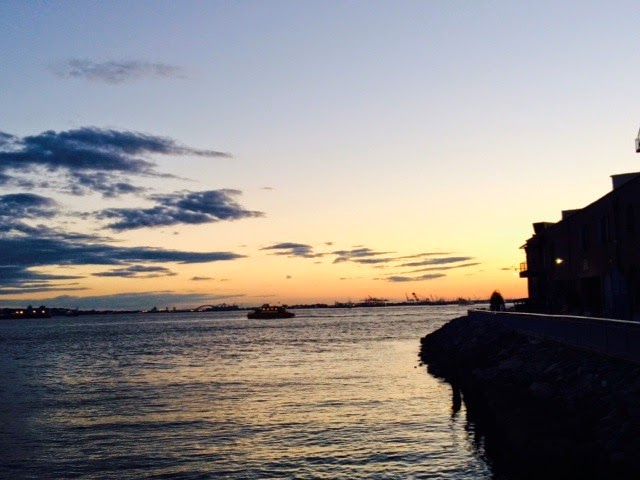
Sunset from Red Hook Winery, BK
So, Wineaux, there you have it—the current Scholium release, "The Complete Summer Selection," which will be ready for delivery in October. I look forward to the wines I have coming, and hope to hear from you if you too are are a fan of the Scholium Project. And as always, I continue to support inventive and daring winemakers around the globe, so hurry back soon Abe, and bring more wines for us "crazy-man-wine-club" members to try!

Cheers.


(ADDENDUM: As I was working on this article, news filtered in about the earthquake in Napa—with many winemaker friends in the area, I reached out with concern. While all people I know are fine, one winemaker lost her total inventory save for what she could salvage from a few broken barrels. Another winery I know suffered catastrophic damage to its historic tasting room. Maybe it's not pouring ice water over your head, but please help support the cleanup and rebuilding of one of our nation's most iconic wine regions by drinking Napa wine, tweeting with #NapaStrong, and supporting these winemakers by buying more Napa wine, like Scholium.)

Friday, May 23, 2014

THE NEW CORNERSTONES OF NAPA, DAY ONE:

When I found out the Oakland As baseball team had invited me out to sing the National Anthem recently, my first thought was "Yippee, I booked team #19 on my Quest!" (Click the link for info on that particular pursuit of mine.) My second thought was, "Yippee, an excuse for a trip to NAPA!"

On prior visits to Napa Valley, I had a group of burgeoning oenophiles to shepherd around, so we had to make the usual stops at Robert Mondavi (perhaps the "Disneyland" of Napa, but a great visit,) and other high-profile wineries that catered to groups like ours. This time I was on my own—a Wine Minx on a mission. I had two days; who knew what I could find?

I sought out places that were more "insider"—wineries the sommeliers loved, or that other small winemakers recommended—to learn more about what was going on beyond the large conglomerates and operations that have somewhat taken over Napa's identity.

On a sparkling Sunday morning, my first stop was Hyde de Villaine, a joint venture of Napa's Larry Hyde and Aubert de Villaine of the storied Domaine de la Romanée-Conti in Burgundy. The two families, related by marriage, developed the idea to collaborate "over the dinner table," said Lawrence "Eddie" Townsend, the HdV sommelier. In an unassuming building on the outskirts of downtown Napa, Eddie and I sat down to taste through four of HdV's current offerings. (HdV offers two options for tasting, the "HdV Flight" of the following four wines' current releases at $45pp, and the "Comandante Flight" which adds two premier wines for $75pp, with fees waved with certain wine purchases. Appointment requests can be made via the above website.)

We began with the 2012 De La Guerra Chardonnay, which had a nose of lemon verbena. On the palate were notes of grass, lemon curd, a whiff of smoke, herbs and a pleasant note of—forgive me, but I really got this—mortadella(!), balanced by a very bright and refreshing acidity. Aged partially in a "concrete egg," there was some resulting autolytic character, which added a bit of weight (and maybe contributed to that mortadella.) $45

Next up, the 2011 HdV Chardonnay, with an incredibly complex nose of aromatic yellow and white flowers, yellow apple, and fresh-cut grass. It was rich but not heavy-handed, with a sublime balanced acidity and a very long finish. Aged 12 months in oak (20% new.) $60

On to the reds! The 2010 HdV Californio Syrah, Hyde Vineyard had a bright, outrageous nose of red fruit, lush herbs, blackberry syrup and was a bit smoky. Its light acidity and integrated but grippy tannins balanced the dark fruit and smoked meat notes on the palate. Long finish. "This is the wine that brought me here," said Eddie, swirling his glass in appreciation. $60

Finally, the 2009 HdV Belle Cousine: a blend of 52% Merlot and 48% Cabernet Sauvignon. Eddie mentioned that most years there was much less CS in the blend, and when I asked why this vintage was different, he told me that the blend is a group decision—Stéphane Vivier, the winemaker, puts together four different combinations, the six members of the team sit down together and taste them blind, and the group's favorite gets bottled. (Which I thought was very cool.) This had a nose of rosemary, a lot of graphite, pepper, herbs, and some green elements. It was fairly dry and earthy, with integrated tannins, licorice, red cherry, a little cranberry zing, red cassis, and some rose potpourri. $60

HdV also offers a handful of library selections (these wines from older vintages,) and some large-format bottlings, but the wines I tasted are basically the heart of HdV. It is a small operation (as I discovered when I called to make my appointment and Stéphane Vivier himself answered the phone.) But it is an elegant one, and committed to making quality wines, blending the ideology of New World fruit with Old World winemaking. When asked about expansion or notoriety, Eddie said that HdV "probably won't be a rock star," but it didn't seem as if anyone there cared a whit about rock star status; they just cared about making excellent wine.

Very pleased by my first small winery visit, I hopped in my car and tootled up Highway 29 to Yountville for lunch at the French Laundry. If you know about "Laundry" (as the locals call it,) you know that it was a meal of a lifetime, and if I was a food blogger, you'd hear ALL about it! (If you do want to peer over my shoulder at the experience, visit my Wine Minx facebook page and scroll down to May 4, when I posted pictures of much of the lovely food and wine I had there over a four-hour extravaganza.)

Completely sated and in a state of zen-like foodie bliss, I meandered down the street to Ma(i)sonry. Billed as a "winery collective," Ma(i)sonry offers tastings of wines from 23 vintner partners in a gorgeous locale where art is also displayed and sold. The website perhaps describes their mission best: "Pairing artisan wines with exquisite art and furnishings in a historic setting." I was joined by my friends Adam Hersly and Stacy Soberalski of Hersly Wines (more on them and their wines soon!)

Ma(i)sonry's main building
We were greeted by our curator for the afternoon, Bex Bishop, a local winemaker who coincidentally I went to college with and had previously connected with via LinkedIn... this unexpected visit was our first actual meeting. (Alas, none of her wines were on the list for tasting, but you can learn more about BX of Napa < here.) I was suddenly feeling very "insider-y!"

We started with a shared flight of whites; first up, the 2012 Lail Blueprint Sauvignon Blanc. Tart nose of grapefruit, very "cheeky" in the mouth with SweeTarts candy and herbs on the long finish. Pleasant and complex, this really grew on me. $40

We also tried the 2011 Lail Georgia Sauvignon Blanc. With 20 months in new French oak, you definitely felt the oaky toastiness in this heavy-duty, big style white. Lemon-lime citrus on the finish balanced the coconut and grassy notes. Someone said, "Hawaiian Tropic," which was kind of true! $120

A few from the collective itself; the 2012 Ma(i)sonry Sans Chene Sauvignon Blanc Hudson had a brief oak aging, and showed more tropical fruits and grass on the nose. Very bright and zingy acid balanced super-ripe melon and a little gooseberry. $32. And the 2012 Ma(i)sonry Marsanne had a lemon/herby/grassy nose, and was very minerally with warm herbs on the finish. Interesting. $38

Next up: a pair of Pinots. The 2011 Pahlmeyer Pinot Noir, aged two-thirds in new French oak, was lovely. Very floral perfumey nose, tart and tangy fruit, purple flowers and rose petals with light red and black fruits. $75. And the 2009 Tuck Beckstoffer Eagle Vineyard Pinot Noir, aged 14 months in barrel and two years in bottle before release. This had a dark ruby color and a nose of really ripe red fruit. In the mouth, there was cherry jam, herbs, and a tart acidity that left this wine a bit disjointed in the mouth. At 14.9% alcohol, with this kind of character, the group felt this wine resembled a Syrah more than a classic Pinot. $85

On to the Cabs! I really liked the 2009 Casa Piena Estate Cabernet Sauvignon with its nose of cassis, berries, herbs, and flint. It was pretty high-octane, but bright notes of violets and lavender and a fresh acidity gave it lift. Super flirty. $150

Bex said about this next wine, "I call it lush and velvety, my colleague calls it 'slutty.'" And I agree with the colleague—the 2010 Coup de Foudre Cabernet Sauvignon (with some Petit Verdot and Cabernet Franc in there,) had a nose of soft red berries, and showed raspberry liqueur on the palate, with herbs and black pepper on the slightly angular finish. My notes say, "Yep, slutty," which is hardly a bad thing. $95

The 2008 Pahlmeyer Proprietary Red is categorized as a "library" wine, as there is very little left in stock. A blend of 76% Cabernet Sauvignon, 8% Merlot, 6% Cabernet Franc, 3% Petit Verdot, and 1% Malbec, this was a lovely and complex wine, with notes of blackberry jam, green pepper, mocha, cinnamon, and bramble fruit with a relatively smooth finish. (No wonder there's not much left!) $125

I was still full from lunch and getting a bit tired from this marathon day of tasting, but we decided to soldier on for one more flight: the excellent 2010 Blackbird Contrarian (43% Cab Franc, the rest Merlot and Cab Sauv,) had aromatic cedar on the nose, with berry salad, "poop & dirt," (again, a good thing,) graphite, licorice, and black fruits on the finish.  $125. And I also liked the 2011 Tor Napa Cabernet Sauvignon, a blend of grapes from three vineyards. At first it was very tart and kind of disjointed, but it opened up and smoothed out a great deal with time in the glass. Blueberries, raspberries, applewood, smoke. Stacy said this would be perfect with braised short ribs, and while still full, I agreed. $80

Finally, the 2011 Lail J. Daniel Cuvee Cabernet Sauvignon. With 100% Howell Mountain fruit, this had a nose of bright red cherries and raspberries, with heady yet soft aromatics. In the mouth it showed herb liqueur and a bit of grape soda, with a slightly awkward, tannic finish. It definitely needs more time to develop but shows good promise. $150

Tasting at Ma(i)sonry is a lovely, unique experience. You can make a reservation for parties of various sizes, and sip away in little sections of a charming courtyard or inside the circa-1904 main building. They are developing a partnership with Restoration Hardware and have bought the lot next door for a themed-kitchen expansion, plus are looking into other locations. However, they state that visiting Ma(i)sonry will remain an intimate experience that is always focused on small vintners.

Fully satisfied, I called it a day, and headed off into the sunset to rest and recoup my taste buds for Day Two. This foray into discovering the "smaller players" of Napa was illuminating and I couldn't wait to see what the next day had in store. (Spoiler alert: excellence!) Stay tuned...

Cheers!


Friday, November 22, 2013

VINO, INDIANA STYLE.


As many of you know, the Minx is also a performer on the stage, and I often get called away to gigs all over the country.  For the past few months, I have been holed up in NW Indianapolis bringing a little comic relief to the drama of "Les Misèrables" eight shows a week.  But that doesn't mean I've forgotten about wine!  Far from it.  I have scoured the local Trader Joe's for sub-$8 finds, I have wandered the rows of Kahn's Fine Wine superstore, caressing bottles as if they were long-lost friends, and I've even visited a winery or two.

Wait, go back a sec - a WINERY?  In Indiana?


You may know that wine is indeed made in every one of the 50 states.  Not all of it is excellent by any means, but as consumer demand rises, more and more "outpost" winemakers want to showcase good product.

I performed in "9 to 5" the musical at this same theatre earlier this year, and right after I arrived for rehearsal, Indiana was granted its own AVA (American Viticultural Area designation.)  I was excited to celebrate with some local wine, but there are still some obstacles before Indiana is recognized as a top-tier winemaking state.

In fact, it may never be; California, New York and the Pacific NW are the historically good areas for US winemaking precisely because their climate, land conditions and proximity to large bodies of water make them the best places to grow wine.  Other states like Virginia, Texas and New Mexico are overcoming geographical obstacles to produce quality wines, but perhaps this particular midwestern state may never get a competitive boost.

That being said, there are a number of wineries in the Indianapolis vicinity, as well as numerous more in the southern part of the state.  They are cultivating international varieties like Merlot and Syrah, but also working with hybrid grapes (a mating of wine grapes - vitis vinifera - and heartier 'regular' grapes from another vitis species) to some success.

One lovely fall afternoon my roommate Stephanie and I swung by Mallow Run winery, located in Bargersville, IN, about 30 minutes southwest of Indianapolis, where they offer a generous sampling of wine to taste.  During our visit, they were pouring from 21 different options.

The property of Mallow Run has been family run for 150 years, although the vineyards were only planted about 13 years ago.  There is a lovely tasting room, and visitors can even buy a glass or bottle of wine and picnic inside or on the grounds.

Stephanie began with the 2011 Mallow Run Seyval Blanc (a hybrid white grape), which was very pale with a 'green' nose, and was simple, clean with light acid.  She found it very appealing. $11

I tried the 2010 Mallow Run Estate Chardonel (another hybrid, much like Chardonnay - the name similarity is no accident!)  It was one of my top picks, with a buttery nose, firm acidity of tart lemon, very dry with a nice body. $17

The 2011 Mallow Run Rosé of Chambourcin (you guessed it, another hybrid) was the color of very pale onion skin.  It didn't have a very expressive nose, but was slightly off-dry, with flavors of strawberry, cherry and some herbs on the finish.  $14

Similar in style to a Pinot Noir, the 2011 Mallow Run Chambourcin had a medium brick-y color, with a smoky nose, and flavors of dried cherries and pepper.  Very pleasant.  $17.

Stephanie thrust her 2011 Mallow Run Syrah under my nose, and I got why right away; there was a ton of floral perfume!  In the mouth, the rose and violets shone through, with spice and pepper and a hint of blackberry liqueur, although this was very light in style.  $19

Another personal favorite was the 2010 Mallow Run Merlot with a somewhat pale garnet color, it had a vegetative nose, but the lush fruit balanced that out.  It was very approachable, with lots of blackberry and blueberry fruit, a hint of oak, and light tannins.  Complex but quaffable.  $19

The 2010 Mallow Run Zinfandel was a medium ruby color, with a tantalizing smoky meatiness on the nose, and plum and dark berries in the mouth.  However, it was a little unbalanced for my taste, with lighter flavors and a bit too much acid; a victim of the growing locale, I expect. $19

Finally, another fave, the 2011 Mallow Run Cabernet Sauvignon.  It had a medium dark ruby color, with tons of berry fruit on the nose.  In the mouth, black fruits and toasty oak were complimented by a smooth tannic structure.  Velvety and dense.  $19

All in all the offerings we tasted at Mallow Run were solid and many were interesting.  I did buy a couple of bottles for later!  And Stephanie and I each chose a glass and grabbed a fruit and cheese plate and enjoyed a gorgeous afternoon in the farmlands of Indiana.

One tricky post-script: with the exception of the off-dry rosé, we didn't try any of the sweeter-styled wines that day.  Actually, the sweet offerings outnumber the dry ones, and it's due to the fact that some of these hybrid and other non-vitis vinifera grapes perform better with natural residual sugar.  But also, the midwestern palate seems almost stubbornly attached to sweet-style table wines; Mallow Run's best seller is their "Rhubarb" wine.  I can't expect a winery to cease production of their most popular products in order to adhere to my desire that traditional wines from unusual locales get the boost they need.  But at the very least, there's something for everyone!

So don't be afraid to go out into the wilds and sample some wines from less-common locales.  You may discover something unexpected!  Cheers.