Showing posts with label Zinfandel. Show all posts

Wednesday, November 19, 2014

TOP 20 UNDER $20 of 2014!!!

It's that time of the year—the mercury drops, the holiday season approaches, the days get shorter… and the Wine Minx posts her "Top 20 Under $20"! Like leaves falling from the tree and shiny-nosed Rudolph, my most popular blog is BACK.


Don't look so forlorn, Andrew—you're buying us wine!
You may recall that last year was a tricky one; I didn't even find 15 wines for the list, alas. But in 2014 I had a surfeit of lovely options to choose from… so there are actually 21 this year. Why not? My blog, my rules!

Yes, there are three rosé sparklers—because they are just THAT DARN GOOD. Chile, Portugal, and Spain had a solid showing (no surprise, they're great for value wines,) but we were nicely spread out all over the world with ten different countries represented, including Greece, Austria, and Morocco. Yep, Morocco. 

I would gladly drink a case of each of these, but will note some particular standouts with a "*" because they deserve it. Okay, enough o' my yakking, let's get to it!


SPARKLING:

2010 Luis Pato Vinho Espumante, Portugal: was served this at Oxheart restaurant when I was in Houston. Amazeballs! Tart and tangy but unusual and herby too. Let it warm up and open up. Delicious. Made from the Baga grape. ~$13.

*NV C. Greffe Vouvray Brut Excellence: nose of taffy and white flowers, orange peel, white chocolate. Pleasing mousse, rich in flavor, a bit of brioche to ground it, straddles the line beautifully between complex and easy-drinking. Well, well, well, what a find. ~$19.

NV Dürnberg Brut Sparkling Rosé, Austria: made from Zweigelt, with loads of fruit! Well-balanced, herby, excellent aperitif, good body and character. Supremely quaffable. An absolute party fave. ~$15.

*NV Louis Bouillot Rosé, Cremant de Bourgogne: light pink. Tasty strawberry and honeycrisp apple. Dry, good zingy mousse, nice balance, long finish, great to pair with pork or T'giving turkey! More, please. ~$16.


WHITE:

*2013 Caliterra Tributo, Leyda, Chile: 100% Sauvignon Blanc. Pale straw gold color, fresh nose of kiwi and gooseberry, lemon, papaya, lime curd. Well-balanced fruit and acidity, grass and fresh herbs on the (long) finish, minerality, kelp/seaweed, quaffable but complex. ~$15

*2012 Feudo Arancio Grillo, Sicily: I drank Grillo as I recently wandered all over Sicily, falling in love with its good weight and body, and lemony, herby character, with intriguing spicy white florals. Feudo Arancio makes a great one, yummmm. And only ~$9!

2012 Saracina Unoaked Chardonnay, Mendocino, CA- white peach, pear, lemon zest, fresh tarragon on nose. Big body, goosed by 4% Viognier in blend, not too high alcohol. In the mouth, tasty fruit and yellow flowers, solid acidity, and minerality on the finish. ~$17.

2012 Ouled Thaleb: white blend (60% Faranah, 40% Clairette) from… Morocco! Pale straw color, melon, grassy, light, spicy finish, lite acid, v. quaffable, minerality, pear, yellow flowers, orange blossom, yellow apple, melon, bit of mint, medium weight, pleasant finish. ~$14.

*2013 Esporão Monte Velho, Portugal: 40% Antão Vaz, 40% Roupeiro, 20% Perrum. Don't let those unusual grapes throw you. Very floral nose, a bit spicy, with white peach and melon. Über rich in the mouth! Luxe. Long finish, just enough acid to balance. Holy cow, love this. A ~$10 STUNNER.

2011 Astica Torrontes, Cuyo, Argentina: pale silvery-gold. Straw and white flowers, rich in the mouth, lemon zest, excellent acidity, long finish. Your next "house white," at only ~$6. 

2013 Quinta da Aveleda, Portugal: 80% Loureiro and 20% Alvarinho— maybe the best Vinho Verde I've ever tried. Not the usual "light and forgettable," it was super-tasty, with green melon, grapefruit, a good body, and steely minerality. Delicioso! ~$9.

ROSÉ:

2012 Domaine de la Sanguliere Rosé Juliette, Provence. Tried this when I was looking for rosés to suggest for a friend's restaurant. Extremely quaffable, loads of berry fruit but also herbs and minerality. Can't stop sipping this one! Don't think about it only for summer, either. ~$13.

RED:

*2011 Cuatro Pasos, Bierzo Spain: Mencía is the grape. A crowd-pleaser for sure. Spicy macerated berries, pepper, smoke, lots of herbs. Complex, with a well-balanced, lengthy finish. On second thought, forget the crowd, drink it all yourself. ~$10.

*2011 Saint George Aghiorghitiko, Nemea, Greece. Tons of floral perfume, rose, violets, bright and tangy in the mouth, cranberry, pomegranate, bit of earth and herbs. Medium-body wine in a light-body suit. Excellent. ~$14.

2013 Campo de Borja Los Dos, Spain: Grenache/Syrah blend. Medium ruby color, bright cherry nose! Bramble fruit. Bit of mushroom and herbs. Spicy in the mouth, with crunchy fruit that turns plush on the long, bright finish. Cheerful and a little sexy. A steal at ~$8.

*2012 MontGras Antu by Ninquén Syrah: Colchagua, Chile. Medium ruby, interesting nose of lilac, violets, pepper, blackberries, clove, licorice, and a bit of oak. Light but lingering spice. Less-ripe fruit on palate, but rich, long, integrated finish. Herbs, touch of vanilla and chocolate, juicy and lovely. (I drew a heart.) ~$12

2012 Underraga Pinot Noir, Maipo, Chile: ripe bramble fruit, blueberry, spice, clove, sweet pork sausage kinda thing, smoke, sage.V bright acidity, needs to be paired with food, yum! ~$11.

2013 Luzon Verde Monastrell - black fruits, plum, heady aromatics, bit of chocolate, not overly heavy-duty. Good acidity, tasty. A very solid offering at ~$10.

*2012 Sobon Hillside Zinfandel, CA: smoky, peppery, black cherry, blackberry nose. Punch of bright berry fruit and ripe plum, lip-smakingly tasty, simmers into long, balanced, soft finish. Super ripe fruit but nice balancing pepper and minerality. ~$12.

2012 Avignonesi Rosso di Montepulciano: cedar, cherry liqueur, bit of licorice, sage. Tasty and well supported by balanced tannins, herby and woody notes emerge over the finish.  Great representation of Italian flair for only ~$18.

DESSERT:

NV Taylor's First Estate Reserve Port, Portugal: the youngest of their offerings and arguably the most approachable. Intense fresh fruit, luscious, quite "wine-like," as its higher alcohol is tempered by the brightness of the fruit. Wow. ~$17.

#          #          #

Well, Wineaux, there you have it. 21 stunning wines under $20. Plenty of variety to get you through Turkey Day, the holidays, AND the New Year, without breaking the bank! Try some, let me know what you liked, or if you have your own 2014 <$20 faves.

Cheers!


Tuesday, September 2, 2014

SCHOLIUM PROJECT: BARREL TASTING 2014

Being a fan of the Scholium Project is a little like being in a quasi-exclusive club run by a mad scientist. I first heard of Abe Schoener and his outside-of-the-box winemaking in a 2013 article in the New York Times Magazine (read it here,) and was instantly intrigued. I got on the mailing list and tasted Scholium wines for myself four months later. Were these wines unconventional? Absolutely. Interesting? Yup. Fascinating, even? You bet.

I ordered a mixed case immediately, have added periodically to my Scholium stash, and believe me when I say it is a tough challenge to NOT open a new bottle every day, especially when fighting the fatigue of "oh, another Pinot, oh, another Chard, oh, another Cab."

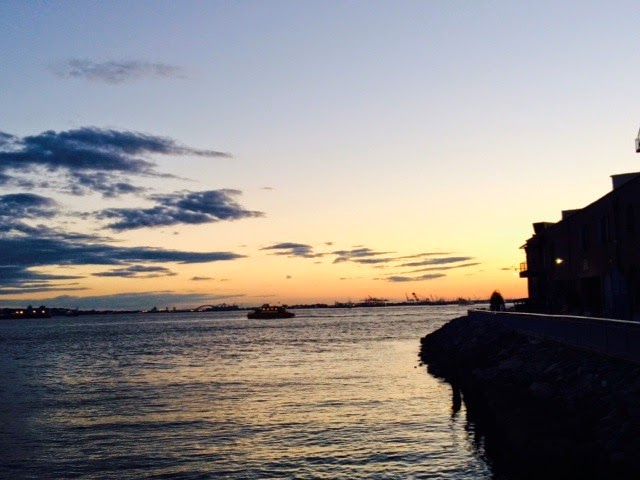
Ferry view of lower Manhattan.
Members of the Scholium "fan club" will do almost anything to get a taste of what Abe has been working on, including trek out to Red Hook, Brooklyn, in a locale far—so very far—from public transportation. I myself took the Ikea ferry from lower Manhattan on a recent beautiful Sunday to participate in the latest "sneak peek" of Scholium Project wines.

The first wine was a 100% Verdelho 2013 Gemella Lost Slough Vineyard. There was only one barrel made (= 24 cases.) A lovely wine. Nose of soapstone, white flowers, a little merde-y, very perfumey aromatics. Spicy in the mouth with a lot of minerality and a long finish, yet not overly acidic. "This is made from grapes that have had the $h!t stomped out of them," said Abe. $45.

A bittersweet moment comes with the 2013 Glos McDowell Vineyards (Sauvignon Blanc.) This vintage was the final harvest from this parcel, unfortunately, as the owners of the land then ripped up the Sauv Blanc vines to plant more popular/profitable Cabernet Sauvignon. Fans of Glos quickly snapped up all of the individual bottles, regular and large-format. With a very pale gold color and a fresh, clean nose of green grass and lime zest, it showed loads of floral perfume with a little gooseberry, and a long charming, elegant finish. "It has the promise of nobility," said Abe, as he spoke bittersweetly about this last-ever bottling. $70

In case you haven't caught whiff of it, Abe's organization is somewhat akin to a pop-up shop. He doesn't own the vineyards he farms, and has a very small, hands-on production operation without a formal tasting room/sales area/oeno-tourism bent. The wines are not always labeled varietally, and there are layers of proprietary names, pulled from colleagues and/or ancient history. He gets fans from word-of-mouth; you have to find him. Production is very low, and loyal followers pounce on each new release, so one must act quickly. Occasionally he will offer single bottles, but usually the only way to ensure snagging these wines is to purchase a mixed-case offering via the website here.

Luckily there is available stock of the 2013 Dulcissima Camilla Farina Vineyards (barrel fermented Sauvignon Blanc,) because I just loved it. My notes say, "Ooooh! nose" of bruised yellow apple, overripe melon and a whiff of sherry-like oxidation. Incredibly complex in the mouth, with ripe fruit, spice, a dried nuttiness, and a looooooong finish. It felt "hot" (high in alcohol) to me, but Abe said the alcohol was relatively low, and that its zingy acidity might be contributing to the presence in the mouth. "This wine is... well, still fermenting," says Abe, explaining that it may not taste the same after bottling! But it's definitely worth a gamble, in my opinion. $45

Rather intriguing was the 2012 Michael Faraday Michael Mara Vineyard 100% Chardonnay. Nose of honeysuckle, Asian spice and pear. Bit cheeky-oddball in the mouth with yellow apple and very spry acidity. Doesn't exhibit "traditional" CA Chard notes at all, and is also slightly tannic. $80

Another fave was the 2013 The Prince in His Caves, made from barrel-fermented whole-cluster fermented Sauvignon Blanc. The color was noticeably darker, a coppery-gold. Nose of ripe apricot, melon, gardenia (notes say, "all ripe & bruised!") Each sniff results in another layer of elements, like a bit of dusty earth, then orange marmalade, then ginger. Very dry/acidic and tannins are present. "This is the wine the Scholium Project is best known for," said Abe, noting they've made this since 2006. You Wineaux know I love "strange" wines, and this is an iconic weirdo-wine; the nose is atypical Sauv Blanc and the mouth experience is very different. I am hooked. $45

The nose of the 2013 FTPZ Kirschenmann Ranch (100% Old Vine Zinfandel) was intoxicating; high tone blueberry, violets, sweet licorice, grounded by a bit o' something funky and meaty. Black cherry liqueur in the mouth. High but appropriate acidity, nice and bright, spicy, lovely, long finish, dried leaf-y element. Whole-cluster fermentation (like The Prince above.) $50

I would probably never have correctly blind-tasted the 2013 Poloupous Antle Vineyard as old-vine Pinot Noir, but that's what it is! Violet, blackberry, bit of funk, bit of rosemary and herbs. It was kind of similar in style to the FTPZ, actually, although more tannic, smoother, and less bright fruit. I look forward to seeing how this evolves and integrates over time. The prominent tannins were what threw me, but Abe said, "That is a very tannic vineyard. And whole-cluster fermentation... I hope to be making 'Priorat' Pinot Noir!" $50

A perennial favorite is the 1MN and the 2013 1MN Bechtold Ranch was no exception. Named after the Malvaisa Nera grape, this is actually 100% Cinsault from a 140-year old vineyard. It had an amazing, super smooth nose of blackberry jam, cherry/berry fruit, and rose petals, and in the mouth added chocolate-covered cherries, pepper, spice box, with loads of perfume and integrated tannins. Just lovely. "This seems, to me, the acme of deliciousness," said Abe, and I had to agree. $50

I did peg correctly the grape of the 2012 Golgotha Reserve Hudson Vineyards. With a dense and rich nose of cherry pie, warm berry compote and spices, I wrote, "Syrah??" And when it was confirmed, I scrawled, "Yessss!!!!" Bright and macerated red fruits rounded out the palate, and yet it's so dense, I can't wait to see what it does over time. "This, for me, is the peak of luxury. I don't think it's the most noble wine, or delicious, but it has the best claim of opulence," said Abe. Abso-friggin-lutely. $180


Another check mark of liking went next to the 2012 Anastasis red; while almost completely Cabernet, there is some Merlot, Syrah, and Sangiovese in the blend. It had staggeringly bright fruit and perfume on a very sexy nose. Perhaps a bit of VA (whiff of nail polish remover) but worked with the major lush fruit on the palate, super smooth finish, and notes of cocoa powder and lavender. This wine originally fell victim to a stuck fermentation, but they were able to restart it, so it was named after the Greek word for "resurrection." $45

Interestingly, the most traditional "Napa Cab"-style in the Scholium Project is the above Golgotha Syrah—the 2012 Wolfskill Reserve Cabernet Sauvignon is decidedly old-school. "We're trying to make Cabernet that is from a certain time and place," says Abe, meaning stylistically closer to 30-40 years ago than today. Intense anise jumped from the nose, along with rosemary, rose petal potpourri and violets. Bright, relatively light, red fruit, bit of cedar and spice box. Yummy. $120

Finally, we were treated to the 2010 Babylon Tenbrink Vineyards. 100% Petite Sirah, 3 years in barrel. Nose: "HUH...!" Asian spice liqueur, melted black licorice, a meatiness like a "blond" German sausage (what is the name for that?!) In the mouth, it was red licorice at the forefront, mace and coriander spices, with dried fruits. "Feels a bit passito?" I wrote, citing the Italian process of drying grapes before pressing. Once again, I was right; "I want this to be like a California Amarone," said Abe, and two tasters immediately chimed in with "It is!" and "That's what you got!" Crazy elements yet still superbly structured and quaffable. $80

Sunset from Red Hook Winery, BK
So, Wineaux, there you have it—the current Scholium release, "The Complete Summer Selection," which will be ready for delivery in October. I look forward to the wines I have coming, and hope to hear from you if you too are are a fan of the Scholium Project. And as always, I continue to support inventive and daring winemakers around the globe, so hurry back soon Abe, and bring more wines for us "crazy-man-wine-club" members to try!

Cheers.


(ADDENDUM: As I was working on this article, news filtered in about the earthquake in Napa—with many winemaker friends in the area, I reached out with concern. While all people I know are fine, one winemaker lost her total inventory save for what she could salvage from a few broken barrels. Another winery I know suffered catastrophic damage to its historic tasting room. Maybe it's not pouring ice water over your head, but please help support the cleanup and rebuilding of one of our nation's most iconic wine regions by drinking Napa wine, tweeting with #NapaStrong, and supporting these winemakers by buying more Napa wine, like Scholium.)

Monday, March 10, 2014

HOT (LITERALLY) WINE DESTINATION: ARIZONA!

Wineaux, were you aware that lil' ol' ARIZONA is manufacturing some really phenomenal juice?!

Yes, land of the saguaro cacti and desert sun, Arizona has three main wine regions and is home to around eighty-three licensed and bonded wineries. I recently visited the Sonoita AVA (located about an hour south of Tucson) to meet some winemakers and sample their wares. [Sonoita is currently the only AZ region granted an American Viticultural Area designation.]

I've tasted wines from less-familiar winemaking states in the past, noting varying degrees of success. Many states, like CT and IN, are often forced to use hybrid grapes to combat the challenges in climate and terroir they face. Others, like MI and NM, find pockets of land where decent vitis vinifera wine can be made. In Arizona, the potential is huge... but there's a reason you may not yet be on the AZ wine bandwagon: availability. Each winery I visited had an incredibly small production, yet most spoke of exponential growth in the near future.

Historically, 16th-century Spanish Jesuit missionaries planted vines in Arizona to make sacramental wine. But strict laws from Prohibition and other legislation put a stop to AZ winemaking until the 1970s when the soil scientist Dr. Gordon Dutt noticed that the red clay Arizona soil had some similarities to that of Burgundy. He was involved in other agricultural projects around the Southwest, but when he got the AZ wine ball rolling, it quickly gathered momentum.  

Now there are around fourteen wineries in the Sonoita area, and on a recent overcast Sunday, I stopped by four of them to see what this little "secret" AVA was about. I was joined by my friend Aaron—a Tucson resident, editor, photographer, and budding Wineau.

Flying Leap Vineyards front porch.
First stop was FLYING LEAP VINEYARDS, INC. Marc Moeller, the co-founder and winemaker, described how he and his partner Mark Beres took over the former Canelo Hills property a few years ago. They absorbed some Canelo inventory, but quickly set to planting vines of their own. Now they have 6.5 acres of vines in Sonoita and about 20 acres in Willcox, another AZ wine region. Flying Leap has the feel of a real working winery, and while Marc wants to double in size over the next six to seven years, he still struggles with juggling the output he has now in his small space, likening it to an ongoing game of Tetris.

As AZ winemakers expand in their booming industry, there are a handful of wines still being made with grapes or juice from other regions—some quite lovely, but I'm going to focus on the unique terroir of AZ fruit, like the 2009 Canelo Hills Zinfandel. Very pale garnet color, lots of black pepper spice and dark fruit. Light but quite spicy with a bit of acidity. Nice pizza-sauce-y character (you know: oregano, tomato stem, that kind of thing.) $22.50

I quite enjoyed the 2011 Flying Leap Graciano. Graciano is more well known in Spain, but is well served here: light ruby color, rich notes of blackberry, black currant, violets, licorice, spice, and a bit of barnyard earthiness on the nose and palate. $29.11

The 2010 Canelo Hills Cabernet Sauvignon was a medium garnet color with an intriguing note of cumin in the nose, and cedar and bright red fruit. Nice balance through the finish, and although it was light in style, it could age well for about five years. $32.96

Aaron's favorite of the tasting was the 2011 Flying Leap Head Over Heels, which was a blend of Tempranillo, Cabernet Sauvignon, Petit Verdot, Mourvèdre, and Merlot. Medium garnet color, heady nose of mesquite, smoke, black fruits, and charcoal. Well blended, and the integrated tannins helped add a solid structure. $30.85

Tempranillo had its own showcase with the 2012 Flying Leap Estate Tempranillo—a medium garnet, very earthy/merde-y character, with fragrant eucalyptus and a nice light but long finish that was smoooooth. $38.33

Marc pulled out his 2009 Flying Leap Sangiovese to share with us: very, very pale garnet with a nose of forest floor, dried spice and caramel, and with those elements on the palate, notes of figs, anise, and dry Madeira. Aaron chimed in that he was getting "butterscotch... and actual Scotch." (Yes!) Very elegant and rich, rich, rich. $31.95

Marc and his tasting room manager Rolf were so approachable, and took pride in greeting every person who came through the door while we were there. Their customer interaction was an early hint that these AZ wineries would be absolutely defined by their proprietors. As we talked more about the wines and their plans for the future, Marc excitedly brought out two bottles of barrel samples for us to try:

The 2012 Flying Leap Grenache was a pale ruby, with smoke and cherry liqueur on the nose, and a mouth of peppery spice, cherry, and a bit of caramel, and the 2010 Flying Leap Graciano was a medium ruby, with violet florals, forward berry salad, quite perfume-y with sweet oak and black fruits and a long, smooth finish.

It is always an honor to be surprised with barrel samples, and Aaron and I headed off to our next appointment wondering if the hospitality was a fluke or would be the norm... and quickly discovered it was the norm.

Entrance at Kief-Joshua Vineyards.
When we arrived at KIEF-JOSHUA VINEYARDS, Kief Manning himself was rushing to find a screwdriver as a klatch of Sunday regulars were having a grand old time in the tasting room. There was an omelet station outside, and a warm, festive atmosphere.

Kief spent some time traveling around Europe as a youngster, and started working at a wine shop at age 15. That led to his experimenting with making wine, which has since snowballed. He wants to stay a relatively small operation, but plans to double in size over the next ten years. When I asked what that would entail, he replied, "Well, we're gonna need employees by that point."

The 2012 Kief-Joshua Cephus (90% Viognier, 10% Chardonnay) was pale with a green tint, lots of tropical fruits on the nose, and tart citrus, pear, and a bit of barnyard as an anchor. $18

I loved the incredible floral tones of the 2011 Kief-Joshua Lacrime Divino (80% Syrah, 20% Viognier) which were enhanced by licorice, a lot of mocha, and light red and black fruits. Soft tannins and a smooth finish. $28

The smooth trend continued with the 2012 Kief-Joshua Magdalena (72% Barbera, 28% Cabernet Franc). Rich, velvety black fruit, notes of graphite and eucalyptus, layers of flavor and mild, integrated tannins. $29. I remarked that his red wines had a nice structure even with the incredibly soft tannins, and Kief said with a shrug, "People don't want to age wine anymore; they want to drink!"

Finally, we sampled the 2012 Kief-Joshua Zinfandel (late harvest). A deep ruby color, loads of fresh rosemary with mesquite and cinnamon on the nose. Very ripe plum and fig in the mouth, this had a somewhat sweet finish, but wasn't at all cloying—my notes say "very interesting,"—while it would pair well with dessert or cheese, I'd be curious to try it with a meaty, flavorful hunk of beef. $32

Already we had tasted single varieties and blends, from international grapes as well as signature grapes from Italy, Spain and the Rhône... yet the wide-ranging potential of Arizona wines seemed barely scratched.

Bocce courts and vines at Lightning Ridge
And the trend of hospitality continued at LIGHTNING RIDGE CELLARS where owner and winemaker Ann Roncone ushered us immediately into her barrel room to taste a number of barrel samples. A former mechanical engineer, Ann began by making garage wine at her home in the Bay Area near San Francisco. Her oenophile interest quickly led her to twenty acres in Sonoita where she took a former grazing property and built a winery from the ground up.

After discovering that "Italian reds like it here," she has focused on red Italian varietals, like the 2013 Lightning Ridge Aglianico, which was a very dark ruby red with a luxe nose of plum and cherry. Some licorice and cherry liqueur came through on the finish, though the wine still seemed a little youthful and green. Ann nodded at her glass and said, "It's like a teenager, being stupid." Guess that teenager will remain confined to his oak "room" for a while!

I really loved the 2011 Lightning Ridge Montepulciano: a heady nose of oregano, with lots of red fruit and spice. Very warm and rich with a long finish of herbs, well-balanced. My notes say, "Fantastic, tasty, slurping," meaning (I think) I wanted to lap this up all day.

As we tasted, Ann clarified the issue behind why Arizona wine was such a mystery to the rest of the country: most estates are so small that they sell almost ALL of their wine on site in the tasting room! Finding a distributor is ultimately not cost-effective. (Perhaps as these wineries grow, they can work together to get more of their wine out to the rest of the country, but for now they are clearly worth a visit if you're in the Tucson area.)

After departing the barrel room, we sampled a few of Ann's current wines, like the 2013 Lightning Ridge Muscat Canelli, with fragrant florals and pear on the nose, a bit of a "grapey" feel, very very light and vinified totally dry. A very pleasant white wine, perfect for an aperitif.

The 2010 Lightning Ridge Montepulciano was also wonderful, with a pizza-dough-y spice, a hint of barnyard, and lovely development, with jammy black cherry fruit, and a well-balanced finish with good acidity.

Although Ann advocates educating consumers about varietals that may be new to them, she does make the fine 2011 Lightning Ridge Cabernet Sauvignon. With a nose of eucalyptus and cedar, and soft cassis and red cherry in the mouth, this very light Cab has an easy, pleasant finish.  (While all prices were not available, most of the Lightning Ridge wines sell in the $22-29 range.)

Front stoop at Callaghan Vineyards
We bid goodbye to Ann to head to our last stop of the day, CALLAGHAN VINEYARDS. Kent Callaghan is one of the pioneers of modern Sonoita winemaking, and Ann herself singled him out as a "standard-bearer" for the region. The tasting room ambiance was convivial, and it was evident that the production area that spread out into the room beyond was an exercise in organization.

In fact, Kent routinely pulls out and replants vines to experiment with many different varieties, and his tasting sheet reads like an encyclopedia of grapes.

We started with his only estate white, the 2012 Callaghan Lisa's: a field blend of Viognier, Roussanne, and Malvasia Bianca. It had a very aromatic nose, with peach and apricot notes, and a long, fresh finish with integrated acidity. $28

Another white from 100% Arizona fruit was the 2010 Callaghan Ann's, a blend of Grenache Blanc, Verdelho, and Symphony (Muscat crossed with Grenache Blanc.) A soapy, lemon nose, with nice mountain florals, soft melon, a bit of pear, and a soft, balanced finish. $25

I quite enjoyed the 2012 Callaghan Mourvedre, with a nose of crunchy red fruit and earth, and notes of pepper and cherry, very juicy and quaffable, nice and bright but with a smooth finish. $28

The 2012 Callaghan Graciano had a dusty, floral nose with a bit of mossy tang. Lots of herbs on the palate, pepper, and a bright note of grapefruit pith. $28

We tasted two vintages of the Callaghan Padres: the 2009 is a blend of Tempranillo, Gernache and Syrah, with a sexy nose of velvety red fruit, good acidity, and raspberry and mocha notes. $35. The 2007 is a blend of Tempranillo, Petit Verdot and Cabernet Franc. Plush nose of blue and black fruits, and cigar leaf, a little merde, nice acidity and apparent tannins. $NA

When I asked Kent about his winery's potential growth, he inferred that he was almost a bigger operation than he wanted to be, and I got the feeling that he'd rather jog right back into the vineyard or the blending room instead of answering any more questions. He did jog to a case in the back of the room and pulled out a few single varietals he wanted us to try: the 2012 Callaghan Petit Verdot, which had strong notes of blackberry, Asian spices and a woodsy quality. Nice density and sexiness in the mouth, with a long finish. $NA. And the 2012 Callaghan Tannat, of which he only made two barrels. I loved the big notes of berry salad and cassis on the nose, with pencil shavings. It's a pretty huge wine, with a bit of grapefruit citrus that keeps it light. Excellent richness and complexity. $NA.

Aaron and I headed back to Tucson with a few of our favorite bottles in the back seat, and I pondered the future of Arizona winemaking. Considering the difficulty in distribution of such small quantities, I wondered how AZ wine would ever claim its deserved place on the U.S. wine map. However, the near-exponential growth of their industry over the past five years does hint to unlimited potential in the future. Unless these wines stay where they are: born, raised and consumed in the neighborhood.

It could go either way, and is up to the winemakers themselves; for as Kent said, "These are people who like what they do—out working in the vineyard, not jetting around, trying to sell wine."

All I can say is that amazing wines are being made in Arizona, and it's worth a trip, if that's the only way you may get to sample them. Cheers!

[All photographs by Aaron Downey ©2014 All rights reserved.]


Friday, November 22, 2013

VINO, INDIANA STYLE.


As many of you know, the Minx is also a performer on the stage, and I often get called away to gigs all over the country.  For the past few months, I have been holed up in NW Indianapolis bringing a little comic relief to the drama of "Les Misèrables" eight shows a week.  But that doesn't mean I've forgotten about wine!  Far from it.  I have scoured the local Trader Joe's for sub-$8 finds, I have wandered the rows of Kahn's Fine Wine superstore, caressing bottles as if they were long-lost friends, and I've even visited a winery or two.

Wait, go back a sec - a WINERY?  In Indiana?


You may know that wine is indeed made in every one of the 50 states.  Not all of it is excellent by any means, but as consumer demand rises, more and more "outpost" winemakers want to showcase good product.

I performed in "9 to 5" the musical at this same theatre earlier this year, and right after I arrived for rehearsal, Indiana was granted its own AVA (American Viticultural Area designation.)  I was excited to celebrate with some local wine, but there are still some obstacles before Indiana is recognized as a top-tier winemaking state.

In fact, it may never be; California, New York and the Pacific NW are the historically good areas for US winemaking precisely because their climate, land conditions and proximity to large bodies of water make them the best places to grow wine.  Other states like Virginia, Texas and New Mexico are overcoming geographical obstacles to produce quality wines, but perhaps this particular midwestern state may never get a competitive boost.

That being said, there are a number of wineries in the Indianapolis vicinity, as well as numerous more in the southern part of the state.  They are cultivating international varieties like Merlot and Syrah, but also working with hybrid grapes (a mating of wine grapes - vitis vinifera - and heartier 'regular' grapes from another vitis species) to some success.

One lovely fall afternoon my roommate Stephanie and I swung by Mallow Run winery, located in Bargersville, IN, about 30 minutes southwest of Indianapolis, where they offer a generous sampling of wine to taste.  During our visit, they were pouring from 21 different options.

The property of Mallow Run has been family run for 150 years, although the vineyards were only planted about 13 years ago.  There is a lovely tasting room, and visitors can even buy a glass or bottle of wine and picnic inside or on the grounds.

Stephanie began with the 2011 Mallow Run Seyval Blanc (a hybrid white grape), which was very pale with a 'green' nose, and was simple, clean with light acid.  She found it very appealing. $11

I tried the 2010 Mallow Run Estate Chardonel (another hybrid, much like Chardonnay - the name similarity is no accident!)  It was one of my top picks, with a buttery nose, firm acidity of tart lemon, very dry with a nice body. $17

The 2011 Mallow Run Rosé of Chambourcin (you guessed it, another hybrid) was the color of very pale onion skin.  It didn't have a very expressive nose, but was slightly off-dry, with flavors of strawberry, cherry and some herbs on the finish.  $14

Similar in style to a Pinot Noir, the 2011 Mallow Run Chambourcin had a medium brick-y color, with a smoky nose, and flavors of dried cherries and pepper.  Very pleasant.  $17.

Stephanie thrust her 2011 Mallow Run Syrah under my nose, and I got why right away; there was a ton of floral perfume!  In the mouth, the rose and violets shone through, with spice and pepper and a hint of blackberry liqueur, although this was very light in style.  $19

Another personal favorite was the 2010 Mallow Run Merlot with a somewhat pale garnet color, it had a vegetative nose, but the lush fruit balanced that out.  It was very approachable, with lots of blackberry and blueberry fruit, a hint of oak, and light tannins.  Complex but quaffable.  $19

The 2010 Mallow Run Zinfandel was a medium ruby color, with a tantalizing smoky meatiness on the nose, and plum and dark berries in the mouth.  However, it was a little unbalanced for my taste, with lighter flavors and a bit too much acid; a victim of the growing locale, I expect. $19

Finally, another fave, the 2011 Mallow Run Cabernet Sauvignon.  It had a medium dark ruby color, with tons of berry fruit on the nose.  In the mouth, black fruits and toasty oak were complimented by a smooth tannic structure.  Velvety and dense.  $19

All in all the offerings we tasted at Mallow Run were solid and many were interesting.  I did buy a couple of bottles for later!  And Stephanie and I each chose a glass and grabbed a fruit and cheese plate and enjoyed a gorgeous afternoon in the farmlands of Indiana.

One tricky post-script: with the exception of the off-dry rosé, we didn't try any of the sweeter-styled wines that day.  Actually, the sweet offerings outnumber the dry ones, and it's due to the fact that some of these hybrid and other non-vitis vinifera grapes perform better with natural residual sugar.  But also, the midwestern palate seems almost stubbornly attached to sweet-style table wines; Mallow Run's best seller is their "Rhubarb" wine.  I can't expect a winery to cease production of their most popular products in order to adhere to my desire that traditional wines from unusual locales get the boost they need.  But at the very least, there's something for everyone!

So don't be afraid to go out into the wilds and sample some wines from less-common locales.  You may discover something unexpected!  Cheers.