Wednesday, September 11, 2013

DISCOVERING WINES OF CRETE (or, DON'T BE SO DIS-CRETE!)


My little map of Crete!

We've seen a rise in quality wine from other parts of Greece and from my new fave winemaking locale, Turkey, so it's no wonder that the Mediterranean island of Crete is getting in on the action.

Is Crete possibly even the birthplace of wine?  Well, there is historical evidence of winemaking as far back as 4000BC, which certainly stamps it as one of the globe's earliest winemaking areas.  Cretan winemaking flourished under Venetian rule in the 1400s but when the island was conquered by the Ottomans in 1669 its wine production decreased.  There was a spark of vino-resurgence with the Greek annexation in 1913… but Greece was a little too unstable at the time, so Cretan winemaking didn’t really start to revive until mid-last-century.  

Now Crete is gaining prominence with careful attention to quality control and the advancement of legal regulations.  Modern winemakers in Crete are actively looking to make quaffable wines which appeal to global consumers across the board. 

As with other parts of Greece and Turkey, however, some of these indigenous grapes are unfamiliar to the rest of the world, are hard to pronounce for English-speakers, and are often written on the label in Greek lettering.  It is my hope that with time we'll see some of those barriers come down and the path toward enjoyment of Cretan wines will clear.

To get you started, these are the main white varieties of Crete: (* indicates most prominent)
Vidiano*, Vilana*, Plyto, Dafni, Thrapsathiri, Muscat Spina and Malvazia - and the main local red varieties are: Kotsifali*, Liatkio, Mandilari* and Romeiko.

There are good plantings of international varieties too: Sauvignon Blanc, Roussilon and Chardonnay for the whites, and Syrah, Mourvèdre, Cabernet Sauvignon and Merlot for reds.

At a recent tasting sponsored by Wines of Crete, I was able to sample some lovely wines that are now being brought into the States.

2009 Alexakis Winery Syrah Kotsifali 
40% Syrah, 60% Kotsifali.  Berry nose, rich in flavor but laser-like clean.  Good balance and finish with a decent structure. ~$15

2009 Boutari Skalani Red
50% Syrah, 50% Kotsifali.  Bright and earthy too. Perhaps a little fumbly but very pleasant fruit and spice. ~$40

2008 Winery Diamantakis Diamond Rock Red
Syrah and Mandilari.  Very nice, smooth and flavorful, great length.  Berries and spice, with a light but good structure. ~$20

2012 Doyloyfaknis Oinopoieio Winery Femina White
Malvasia di Candia.  Aromatics!  Florals and tropical fruit, with a little CO2 'shpritz,' super light, great for summer, not too crisp. ~$15

2012 Douloufakis Winery Vidiano Dafnios
Chardonnay-like, light in style, with notes of lemon, yellow apple and hay. ~$13

2012 Manousakis Winery Nostos Roussanne White
Nose of straw and lemon zest.  Good length, nice body.  Lip-smacking melon in the mouth, very nice. ~$22

2007 Manousakis Winery Nostos Blend Red
Syrah, Grenache, Mourvedre, Roussanne  (My notes indicate this winery uses 100% Rhône varietals.) Tightly packed berries, some earth/woody elements, long finish, nice structure. ~$23

Although these next two producers don't yet have importers or distributors, I also really enjoyed a few of their wines:

2012 Anoskeli Winery Ano Rosé
Super strawberry nose, loads of fruit, nice length, hint of tannin, very nice.

2012 Nikos Gavalas Efivos White
Spinas Muscat and Sauvignon Blanc.
Bit of grassiness with good floral compliment, mouth-watering, not too acidic, a little tropical fruit – banana! Flavorful.


Ultimately, some of the wines I sampled over the course of the tasting were not terribly complex or interesting, but the wines listed above were certainly user-friendly and quaffable.  Keep on the lookout for wines of Crete as the quality will certainly continue to rise!  Cheers.

Tuesday, August 20, 2013

SAYING 'SHALOM' TO ISRAELI WINES

The Minx is finding this a banner summer for exploring less-familiar wine regions: first Turkey, now Israel! You, dear reader, may already be acquainted with quality wines from Israel... but the majority of Wineaux are not, and there are a few reasons for this.

First of all, Israel lacks a defining grape or signature region that jumps out to make an easy association.

Unlike, say, the Bekaa Valley in Lebanon (which is known for growing Cabernet Sauvignon with an identifiable terroir tang,) Israel's wine regions grow many international varieties well.  Both Chardonnay and Sauvignon Blanc thrive, along with Riesling, Viognier and Gewürztraminer for the whites.  For reds, Cabernet Sauvignon, Merlot, and Syrah all produce many quality wines, and there is increased experimentation with Carignan and Petite Sirah.  In addition, a few indigenous grapes like Argaman (cross of Carignan and Portugal's Souzao) and Emerald Riesling round out the wide array.  Not to mention, wine is grown in nine major spots, from the northern Golan Heights region all the way south to the Negev, in a country roughly the size of New Jersey.

Israel also does not have to adhere to wine laws like many other countries in terms of appellation rules, so they are free to experiment in their vineyards.  While this is potentially a positive situation, it adds to the muddle.  Luckily, advances in technology are helping overall quality rise, so Israeli winemakers are starting to work towards defining a clearer Israeli wine identity.

But... they are also fighting "the 'K' word."

People often associate Israeli wines with lower-quality kosher offerings, which couldn't be farther from reality.  Not all Israeli wine is kosher, in fact, 80-90% of local winemakers are not even Sabbath observant. Winemakers from Israel will tell you that the biggest challenge they face is getting their wines out of the kosher section of the wine store... into the WINE section.  While Israel arguably makes the highest-quality kosher wines out there, detaching the labeling from the wine's level of excellence is another hurdle.

Israel is ripe for becoming a major player in the international wine arena, even with these obstacles.  There are many boutique wineries and self-trained winemakers, they don't hesitate to bring in experienced foreigners or send their youngsters out for training, they are looking to reduce yields for higher quality and they are experimenting with interesting blends.

Perhaps out of all of this, Israel's wine identity will start to take a sharper focus.  Until then, keep your eyes out for some of the following amazing Israeli wines and ponder Israel's wine identity for yourself!

2009 Barkan Wine Cellars Altitude +720
100% Cabernet Sauvignon; Galilee.  Great fruit and cedar nose, intoxicating, chewy, cheeky, approachable. ~$46

2011 Carmel Winery Kayoumi White Riesling
Galilee.  Water-white color, honeysuckle, hint of petrol.  Light acid, great character.  Yum! ~$24

2009 Carmel Winery Mediterranean
27% Carignan, 27% Shiraz, 27% Petit Verdot, 15% Petite Sirah, 3% Malbec, 1% Viognier; Galilee. Earth and spice.  Very, very soft finish with good fruit.  Quaffable.  ~$50

2009 Carmel Winery Sha'al Gewürztraminer
Galilee.  Single vineyard, late harvest - spice, florals, not overly sweet, good acid... great for food pairing!  ~$22/375ml

2012 Dalton Winery Rosé
Blend of Barbera, Cabernet Sauvignon and Syrah.  Unusual wow-nose of floral perfume.  Good acidity. Very yummy - great fruit, great length. ~$17
My notes are for the '10 - the
'11 is becoming available too.

2010 Dalton Winery Petite Sirah
Incredible nose!  Very dense; licorice, charcoal, blueberry liqueur.  Very, very nice. ~$22


2010 Domaine du Castel Grand Vin
Blend of Cabernet Sauvignon, Merlot and Petit Verdot; Judean Hills.  Cedar, earth, cassis.  Mouth-painting with lovely violet and red fruit notes.  Mmmmm.  ~$65

2007 Ella Valley Vineyards Merlot
Merlot with some Cabernet Sauvignon; Judean Hills.  Oak, dirt, terroir, little funk.  Soft tannins, though grippy in mouth.  Bright fruit, good structure. ~$30

2010 Flam Winery Cabernet Sauvignon Reserve
85% Cabernet Sauvignon, 8% Merlot, 6% Cabernet Franc, 3% Petit Verdot; Upper Galilee.  Earth, cherry-berry.  Loads going on!  Well-structured, great length and fruit.  ~$59

2010 Galil Mountain Winery Pinot Noir
Upper Galilee.  Very light in color.  Earthy nose, quite interesting with good elements but very lightly styled.  ~$20

2008 Golan Heights Winery Yarden Pinot Noir
Northern Golan Heights. Lots of floral perfume and earth.  Chewy fruit.  Very nice.  ~$16

2010 Gvaot Winery Herodion Cabernet Sauvignon
92% Cabernet Sauvignon, 8% Merlot; Shomron.  Bright berry color.  Nice round fruit, some earthiness, good acid.  Very pleasant wine.  ~$40

2005 Hevron Heights Winery Jerusalem Heights
Pretty even Cabernet Sauvignon/Merlot blend; Judean Hills.  Terroir, red cherry juice! Fairly soft and light but quaffable with supple tannins.  ~$33

2011 Recanati Winery Ltd. Carignan
Upper Galilee.  Pungent nose - loads of red and black fruits.  Nice florals on finish.  Very good!  And tasty - it keeps drawing you back.  ~$48

2009 Carmei Zvi Segal Bros. Segal's Single Vineyard Dovev Argaman
100% Argaman; Galilee.  I sought out this 'indigenous' grape to try it; this was earthy with lavender florals and black fruits.  Somewhat one-dimensional in the mouth, but brightly styled and interesting.  ~$36

2012 Teperberg Winery 1870 Terra Sauvignon Blanc
Shomron.  Grassy with tropical fruit, great acid, very nice elements and good length.  ~$18

2010 Teperberg Winery 1870 Terra Malbec
Judean Hills.  1st Malbec in Israel, I believe - very dark berries on the nose.  Soft and smooth.  Good for people who like lighter-styled wines with a rich flavor. ~$31

2010 Tzora Vineyards Misty Hills
55% Cabernet Sauvignon, 45% Syrah; Judean Hills.  Loads of cedar and cassis.  Spicy, a bit harsh in the mouth - needs food and/or a little time.  ~$60


A huge thank you to "Wines of Israel - Mediterranean Inspiration" for hosting a mini-wine tour, a discussion of modern Israeli winemaking with Josh Wesson and Alex Haruni, and a walk-around tasting.   My eyes were certainly opened, and I hope you venture out to try some wonderful Israeli wines soon. Cheers!

Thursday, July 25, 2013

You Say ŞARAP, I Say SHUT UP!

This past May, my Wineau friend Carol and I somewhat randomly chose the beautiful country of Turkey as a tandem vacation destination.

Normally when making international travel plans, I would opt for places with storied wine regions I have yet to visit, like South Africa, Chile and New Zealand.  But the travel package to Turkey was too great to pass up, so I said, "Well, they probably make at least some wine in Turkey, right?"

How was I to know... they make some gosh darn amazing wine in Turkey!

(And the word for wine - şarap - is easy, just say "shut up" quickly. Ha!)

Now, you have almost certainly NEVER HEARD OF THESE GRAPES before.  In the extremely comprehensive 2010 edition of Oz Clarke's "Grapes & Wines" - which lists information on almost a thousand grape varieties - the only Turkish indigenous entry is Boğazkere ('Bo-az-ker-ay').  And all the entry says is, "Turkish grape giving decent, deep-colored, alcoholic wine."

What about Narince? ('Nah-rin-jay')
What about Öküzgözü? ('Euh-kooz-guh-zoo')
What about Kalecik Karası? ('Cal-eh-jeek Car-ah-suh')
What about Syrah?  Oh wait, that one you know.

Blue Mosque, Istanbul
Yes, international grapes like Syrah, Cabernet Sauvignon and Sauvignon Blanc - even Sangiovese and Tempranillo - grow well in Turkey, but it's these quirky native grapes that shine and are completely deserving of awareness around the rest of the world.

So, why haven't we all gone nuts over Turkish wine like we have over Greek wine (with its similarly hard-to-pronounce local grapes) or for wine from other niche countries like Lebanon and Bulgaria?
Turkish Delight

Two reasons: Identity and Awareness.

In terms of identity, Turkey is a primarily Muslim country, albeit a relatively liberal one.  So many outsiders just assume no one will drink wine, let alone make wine there.  NOT TRUE!  But most Turks opt for beer or the local anise-flavored spirit rakı, so it's even hard to get locals excited about their country's wine.  And let's not forget those crazy-named grapes.  Euh-kooz-guh-WHAT?

As for awareness - well, you and I are taking care of that right now, aren't we!

When our tour was in the capital city of Ankara, I was able to arrange a visit at Kavaklidere, Turkey's largest winery.  Mr. Onur Özgül, their foreign trade specialist, took Carol and me on an extensive tour of the facility there, including the on-site bottling operation and a small "test vineyard" outside of the production building.  Then we were joined by Mr. Fehmi Atak, the trading director, to taste through some of their wines.

Kavaklidere is large in volume and production.  It is the only Turkish winery with three centers for grape processing, which reduces the time the picked grapes spend in transport from far reaches of the country.  (Most Turkish wine regions are in the western half of the country, although there are a few notable areas in the east.)  Their portfolio consists of forty-nine different wines (yes, that's a lot!) ranging from entry-level wines up to multiple award-winning prestige offerings, and including semi-sweet, sparkling, and fortified selections.

Production facility and test vineyard
The only Turkish wine I'd ever tasted before, I realized, had been from Kavaklidere (see my 2011 post on some NYC Wine Bars) - and in Turkey, their wines were prevalent in nearly every hotel bar we passed through... and we passed through a lot.

I won't bore you with details about the little old ladies who come in to destem the grapes by hand, or the length of maceration time for each grape, or the storage capacity for their tanks... but I will say that the effort to run a modern facility that produces wine to be competitive in an international market is quite strong.

Mr. Özgül said with almost a fervor, "This is where wine came from in the beginning.  Wine is a culture in Turkey; we need to develop this culture."

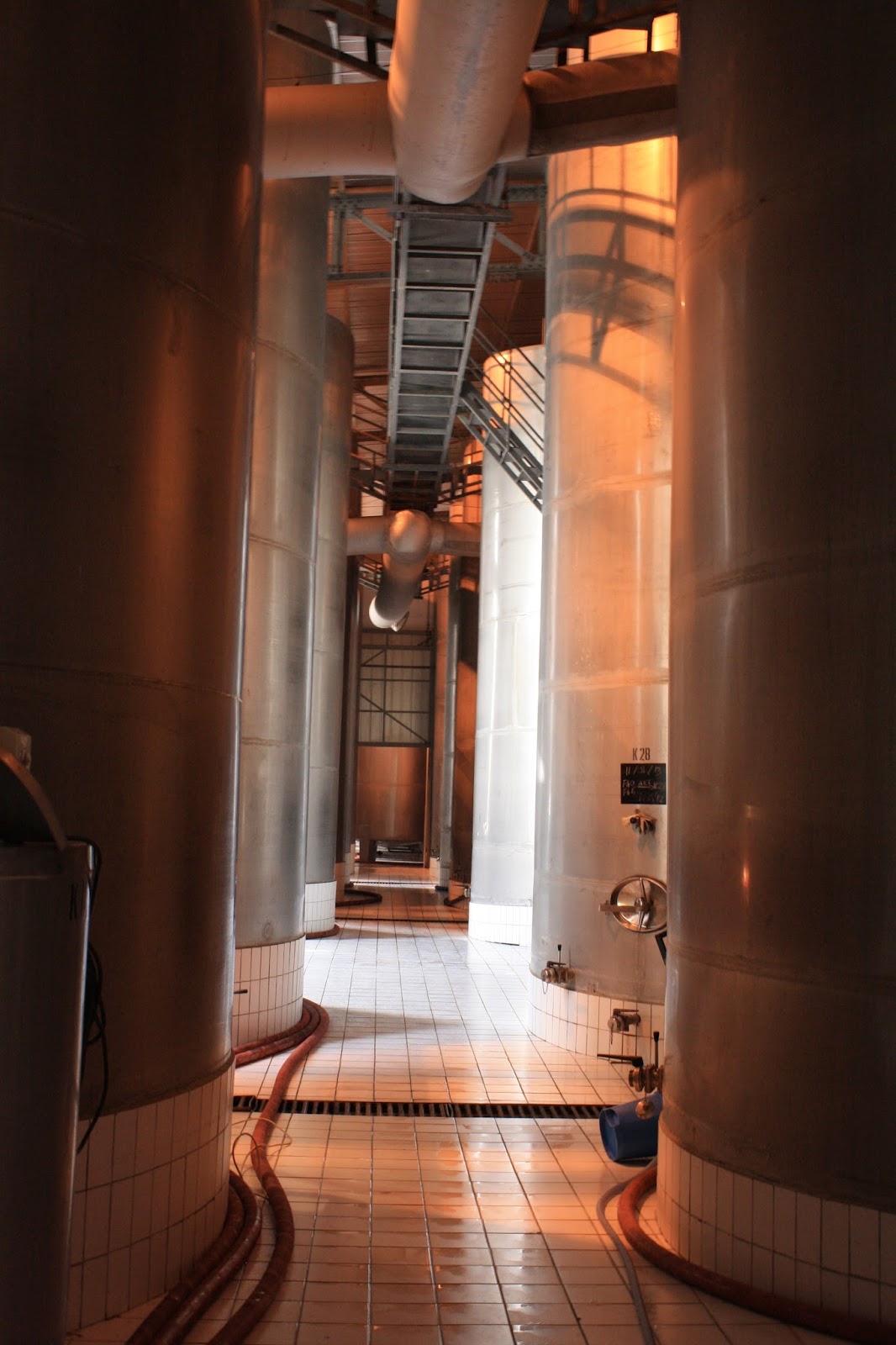
Stainless Steel tanks
Kavaklidere does export twenty percent of their production, mostly to Turkish restaurants in other countries.  But a recent search on wine-searcher.com also showed a decent amount of Kavaklidere wines available at wine stores in the States.  (With mid-range wines priced $8-12 and the Prestige topping out at $30, you can definitely afford to give them a try!)  While they do want to raise brand awareness at home, Mr. Özgül said their "goal is to present our wines in international markets, not only in Turkey." And recently, their efforts have intensified and paid off - over the past five or six years, they've attended more and more international wine competitions, and the medals have started to pile up.

In addition, Kavaklidere is proud that in a historically male-dominated society, both their prior and current winemakers are women, and also that their company's team is mostly young with a large amount of women members.  It is a vibrant, modern group, passionate and ready to bring Turkish wine to the world.

Sadly, just as their trajectory is intensifying, they are being hobbled by governmental controls.  While I was in Turkey, strict legislation banning all advertisement of alcohol and restricting hours of sale was passed.  While neither of my Kavaklidere hosts alluded to these harsh restrictions, their business will almost certainly suffer.  The future of the Turkish wine industry is one more uncertainty stemming from governmental crackdowns and subsequent public dissatisfaction.

(For a firsthand take on the situation in Turkey that began while I was there - the protests about razing trees in Gezi park, the subsequent overly-harsh reaction by police using tear gas and water cannons, and the escalating protests that encapsulated many peoples' anger over too-strict government controls - please see this post on my personal blog.)

Okay, okay - I know you really want to get down to business: WHAT ABOUT THE WINES?!

We started with the 2011 Prestige Narince, a single-vineyard, 100% Narince from Kappadokia.  It was medium-pale straw gold, with a nose of apple, hay, minerals and lemon.  In the mouth, there was tropical fruit and lush minerality, noticeable terroir, with medium acidity and a long, creamy finish.  A very nice wine, a bit reminiscent of a well-made unoaked Chardonnay.

Also from the volcanic soils of Kappadokia was the 2011 Côtes d'Avanos Narince-Chardonnay.  (If Narince evokes Chardonnay, it's no surprise they would blend well, yes?)  About 70% Narince, 30% Chardonnay, this spent nine months in French oak barrels.  A medium yellow gold, with a nose of honey, lemon, and a little butter, in the mouth it showed a steely minerality and very clean finish with medium acid.

I quite enjoyed the 2012 Egeo Roze (rosé) from Anatolya.  A blend of 60% Çal Karası and 40% Grenache, it had a pale color of salmon/ onion skin.  The nose was warm, of light tart cherry fruit and minerals.  It was very, very dry, with lots of acidity but not too bracing, and fruit that went on and on, with rose petal and geranium florals and a bit of salinity.


2012 was a difficult vintage in Turkey, but some wines showed well, like the above roze and the 2012 Ancyra Muscat.  This grape is similar to Muscat of Alexandria but local - there are numerous variations of the Muscat grape all over the world.  Although this had nine milligrams of residual sugar, it exhibited dry.  The color was a very pale greenish gold.  Across the board, this showed tremendous varietal character - incredible floral aromatics, very light and refreshing, with medium acidity, a little residual CO2 'shpritz' and a note of taffy candy.

Now to the reds!

First up, the 2010 Pendore Öküzgözü (I was told that's Turkish for "bull's eye," though Google Translate doesn't seem to agree.) It is from an area near Izmir, a city on the Aegean seacoast, and is medium-dark ruby, with a nose of dusty terroir and berry salad.  In the mouth there is red plum to boot, and it is rich in earthy/berry flavor but light in style with good acid and soft tannins.

Next we sampled two more from the Prestige line, first the 2009 Prestige Kalecik Karası.  This grape actually originated in Ankara, about 40 km from where we were tasting.  It was light garnet in color, with a nose of dried cherry and sage, and in the mouth there was a hint of oak and lots of violet florals with a loooong well-balanced finish.  (I wrote, "yummmmy" and even put a star next to it.) If you're a fan of Pinot Noir, this would be right up your alley... it was very quaffable and I was wishing we'd stop spitting and have some hors d'oeuvres already.

Finally we tasted the powerhouse of the group, the 2009 Prestige Boğazkere.  That word means "throat-burning," which you'd think would normally put tasters off, but as it was the most structured and tannic of the group, I kind of see what the ancient Turks were going for when they named it.  It came from a vineyard in Diyarbakır, which is the most south-eastern wine region in Turkey. This was a dark ruby color with a nose of cherry liqueur, wet leaves, and blueberries.  In the mouth, there was tart red fruit yet it had a masculine feel with a very long finish.  It was definitely different and interesting (though I also wrote, "a little strange," but you all KNOW how I love weird wines!)

Unfortunately, we were not able to stay longer and go through the 42 other wines, but I would have certainly made the attempt if asked!  While some of the entry-level Kavaklidere offerings that I had been able to try in other parts of Turkey were very simple, fine but forgettable, the majority of these wines I found very impressive.

Although there is currently a relatively low availability of these wines in the States, I encourage you to make the effort to seek out Kavaklidere and other Turkish wines (Kayra is another good and somewhat avaliable producer; I have tasting notes from the very yummy 2009 Kayra Vintage Öküzgözü Single Vineyard on my Wine Minx facebook page.)

Wineaux like myself are doing what we can to encourage importing and distribution, as so many of us have gone gaga over these wines once we've had the privilege of tasting them.  I look forward to hearing about your Turkish-wine-treasure-hunt, and what you think about them!

Evil eyes to ward off bad spirits
Detail of sarcophagus at
Antalya Archeological Museum
Since the choice of Turkey as a vacation destination was really quite random, I truly felt as if every wonderful thing I came across there was a special gift; the people, the scenery, the history, the food, and especially the wine.

If Turkey has not yet been on your radar, I strongly suggest you put it at the top of places to visit next!

Library facade at Ephesus
Drink well, and Cheers.
Carol and I having just a miserable
day aboard a boat, about to take
a dip in the Turkish Mediterranean


Wednesday, May 15, 2013

MAD FOR MADEIRA

Wineaux, I hesitate to write about Madeira.  It is a special wine, not always easy to find, a little confusing, somewhat specialized and often exceedingly expensive. But Madeira is so amazing; there is no other wine like it.

It is a sweet wine - but not a swap-out for dessert like Sauternes might be.

It often has a steely salinity not unlike Sherry - but you won't mistake it for Sherry.

And Madeira is basically indestructible - you can leave a bottle open for years and it will never go bad.

Madeira is a fortified wine that is also subject to a heating process (which accounts for the indestructibility) made from indigenous grapes called Sercial, Verdelho, Boal and Malvasia, plus the workhorse grape Tinta Negra Mole, blended or alone.  Named for the island from which it comes, Madeira is made in a range of styles ranging from drier to sweeter, usually seen in association with those different grapes.

I recently sampled a number of Madeira wines that showcased the range of possibilities you can find from these wines.  Some favorites included:

The Henriques & Henriques Rainwater had a light gold color - at three years old, it was one of the babies at the tasting.  It had a nice buttery element, both in texture and somewhat in flavor, with a hint of saline.  The Rainwater designation refers to a lighter style of Madeira that is more approachable and the H&H showcased that beautifully. ~$18

My favorite offering at the Blandy's table was the Blandy's Colheita Malmsey 1994.  A light mahogany color, it showed nice elements of floral perfume on the nose in addition to more traditional notes of caramel and sweet oak.  It was rich and nicely balanced. ~$48/500ml


The star of the tasting, in my opinion, was the D'Oliveira Verhelho 1912.  Granted, most of the tasting's offerings were more common and/or recent vintages, so there were not a lot of Madeiras at this level to compare.  But I have a bottle of 1898 Blandy's Reserve Terrantez (a rare "fifth" grape) open at home which is pretty darn tasty, so I have some experience with long-aged Madeiras.  The D'Oliveira had the most incredible nose of lilac.  The florals in the mouth combined with a toasty caramel and lots of acidity.  Just a beautiful wine.  ~$400


So don't be afraid to give Madeira a try.  The lighter and less-sweet styles - Sercial and Verdelho - are lovely as an aperitif, and the sweeter styles - Boal and Malmsey - will go beautifully with dark chocolate cake.  In fact, adventurous Wineaux should have a lot of fun coming up with interesting food pairings for Madeira.  And don't let the price scare you away; a glass once a year at a special occasion will make the bottle last and last, giving you a very hedonistic bang-for-the-buck!


Wednesday, May 8, 2013

PORTUGAL'S PARADOX


About once a year on this blog, I extol the virtues of wines from Portugal.  I can't help it; they are delicious, generally quite affordable, appeal to a range of preferences and are becoming easier and easier to find.

So how come y'all don't know more about Portuguese wines?!?!

I'll tell you why: CONFUSION.  To start with, there are over 250 different grape varieties in Portugal, and these are not your typical Chardonnays and Shirazes.  Also, wines are made in regions that span the entire country without much of their own brand awareness (i.e., not "Bordeaux".)  Hence the paradox - what makes Portuguese wines so wonderful is precisely what makes them so hard to understand.

So what is a Minx to do?

Well, I will just keep chipping away, Wineaux, tantalizing you with mouthwatering descriptions and low price points.  (Eventually it'll stick!)  Ready?

If you're looking for a nice summer white, try the 2012 Aveleda Vinho Verde.  Most Vinho Verdes are a blend or made from other grapes like Loureiro but this is 100% Alvarinho (= Spain's Alvariño) and it has floral aromas with a hint of salinity and lemon curd.  In the mouth it is bright and acidic with a light melony finish.  I'm already feeling the summer sun.  ~$10

You know how I like strange wines?  I really liked the oddness of the 2009 Campolargo Arinto from Bairrada.  It's 100% Arinto (if you've even heard of that grape) but has a somewhat Chardonnay-like vibe.  The nose was full of straw, hazelnut, ripe melon, dried herbs and a nice earthiness.  In the mouth it was somewhat bitter - not a bad thing - with medium acidity but a LOOOOOOOONG balanced length.  Odd, maybe, but very intriguing.  I should try it again with grilled swordfish! ~$19

For a multi-faceted and slightly hedonistic white, try the 2011 Esporão Branco Reserva from Alentejo.  A blend of a bunch of some more grapes you've never heard of (Antão Vaz, Roupeiro & our new pal Arinto) and one you may have (Semillon), this has a nose of white flowers and butterscotch.  The mouthfeel is round, with flavors of taffy, citrus and melon, and the finish is nicely balanced with medium acidity.  I'm definitely snapping up some of this baby.  ~$15

White wines from Portugal are finally reaching a competitive level of quality, but the table reds have been knocking Wineau socks off for a while now.  Take the 2007 Quinta da Garrida Aliança Reserva from the Dão: a blend of Tinta Roriz (same as Tempranillo from Spain), Touriga Nacional with a hint of Jaen, the nose shows bright blueberry and black raspberry.  In the mouth it is light and pleasant - a great option for those who like lighter-styed red wines - with good fruit and a light structure of mild acidity and hardly any noticeable tannin.  This is elegant and complex with age-related notes of herbs and dusty cherry. ~$12

If you want a little more structure, try the 2010 Quinta do Casal Monteiro, Colheita Seleccionada DOC from Tejo.  The nose blossoms with ripe crunchy fruit - berry salad galore - and a bit of green stemminess with violet florals.  While more structured than the Aliança, it's still a light, pleasant quaffable red.  You've gotta try this, especially for ~$10.

Are you a fan of Italian wines?  The 2007 Monte da Penha Tinto Reserva has the elegant earthiness of many Italian favorites in spades.  It's a blend of Trincadeira, Aragonês, Alicante Bouschet and Moreto.  (I could just say "blah blah blah blah blah," but I do want these names to become familiar!)  With a nose of sweet oak and dark chocolate, it is dense and dark with a long, integrated, luxurious, earthy finish.  ~$18

Regular readers will know I like oddball wines and I looooove SEXY wines.  The sexiest wine of the day was hands down the 2009 Quinta do Passadouro Reserva from the Douro.  It's what is called a "field blend," meaning that the plantings are so old and unregulated that a bunch of different varieties grow and are picked and processed all a-jumble.  But they are (pretty) sure Touriga Nacional, Touriga Franca, Tinta Roriz and Sousão are in there somewhere!  This nose has candied lavender, blackberry liqueur and blueberry pie.  I could smell this baby all day.  But there's more: in the mouth, it is velvety, dense and ripe with apparent tannins and BIG fruit.  It could use some more time to age but I definitely won't turn a glass down now.  ~$14.

While Portugal is historically known for Port, its other dessert wine that you must meet is Moscatel.  I loved the 2009 Bacalhôa Moscatel de Setúbal from the Setúbal Peninsula.  Coppery orange in color, it had a nose of toasted caramel with a bit of apricot and orange peel.  In the mouth, its high acidity balanced the sweetness so it was not cloying at all, and the fruit expression was lovely.  Have it with a foie gras course or at the end of the meal with cheese, or even chocolate. ~$12

All of the above wines were handpicked by Master Sommelier Evan Goldstein for a Wines of Portugal event.  During the walk-around tasting afterwards, I sampled some other favorites, although I have had a little difficulty ensuring their availability.  They all do have importers, so some of you might come across them!

White: 2012 Quinta do Casal Monteiro, from Tejo, made from Arinto and Fernão Pires.  Herby and floral nose.  Crisp and clean for summer, herbs and lots of lemon but not overly acidic.  ~$10

Rosé: 2012 Casa Cadaval Padre Pedro, also from Tejo and a blend of Touriga Nacional, Aragonez and Merlot.  (Merlot!  You know good ol' Merlot.  Oh, but this is a rosé... so it's still confusing.)  Great floral nose, with tons of strawberry and mineral notes, very quaffable and very tasty. ~$12

Red: 2009 Duorum Reserva Old Vines João Portugal Ramos.  Sweet oak, dense and concentrated, abundant florals, tightly packed fruit, high structure, big and brassy.  ~$25

#     #     #

So there you have it, the latest in my treatise championing the virtues of Portuguese wines.  Even if your local store doesn't have any of these particular wines, ask your merchant for recommendations that will suit your palate (not to mention your pocketbook.)  I look forward to hearing about your new favorites as we work to eradicate this paradox.  Cheers!

Friday, April 5, 2013

2010 BORD-EAUX-LA-LA...


It may come as no surprise that 2010 is supposed to be another stellar vintage in Bordeaux.  It seems after 2000, 2005 and 2009, the critics are unanimously weighing in with enthusiasm about yet another incredible vintage.  And guess what?  I agree.

In January, I attended the Grands Crus de Bordeaux 2010 Vintage tasting in New York City.  (At this point in my Minx-dom I do not get invitations to fly over for En Primeur advance tastings, but I will.  Oh, I will.)

I did not have a lot of time to taste leisurely at this event, and realize my notes have more than a few holes, but this quick-and-dirty experience was still overwhelmingly positive.   The one sub-region where I felt the wines did not immediately express themselves to the high level I expected was Pauillac, but I do expect these wines to develop.  I also wanted a little more from the dessert wines of Sauternes and Barsac, however, these also need time to grow and mature.

That's a big point, actually: tasting Bordeaux wines so soon after release is a kind of infanticide.  They are meant to age and evolve, some for decades.  And yet we Wineaux have to pounce on the new vintage, shouting our critiques from the rooftops.  While many of these wines are enjoyable now (albeit rough and tumble,) if they intrigue you, be sure to put aside some bottles and take the journey of a true Bordeaux-lover over the next twenty years.


A COUPLE OF WHITES: (These you can drink now!)

Château de Fieuzal Blanc (Pessac-Léognan) : 70% Sauv Blanc, 30% Sémillon.  Very pale with an aromatic nose, quite tart but excellent fruit and SweeTarts candy.  I like. (~$60)

Château Pape Clément (Pessac-Léognan) : 51 Sauv Blanc, 33 Sémillon, 13 Sauv Gris, 3 Muscadet.  FLORAL aromatics (hello Muscadet/Sauv Gris?!) tangy, interesting. Well-intigrated.  (~$160)


THE MAIN EVENT: 

Châteu de Fieuzal (Pessac-Léognan) : 70 Cab Sauv, 10 Merlot, 10 Cab Franc, 10 Petit Verdot.  Bright fruit, strong expression.  Very nice.  (~$60)

Château Haut-Bailly (Pessac-Léognan) : Very earthy, merde-y, light fruit, more terroir and leather, supple tannins. (~$150)

Château Pape Clément (Pessac-Léognan) : Nice nose, quite soft considering youth, very tannic but smooth, black cassis.  Very nice. (~$210)

Château Beauregard (Pomerol) : Soft violets, dark berries, bit of dusty tannins and chocolate. (~$55)

Château Clinet (Pomerol) : Black fruits, tightly wound.  Chocolate, some lavender.  Wow - can't wait to see what this does in a few years! (~$170)

Château La Conseillante (Pomerol) : Violets, gorgeous amazeballs nose.  Rich, velvety, herbs - somewhat light fruit on the finish. (~$250)

Château Belgrave (Haut-Médoc) : Cranberry, strawberry, very nice feminine style - flirty.  Florals and herbs on the finish. (~$40)

Château Cantemerle (Haut-Médoc) :  52 Cab Sauv, 35 Merlot, 8 Cab Franc, 5 Petit Verdot.  Dense - brick dust, dirt, dark red cherries.  This will take a WHILE to develop.  (~$45)

Château La Lagune (Haut-Médoc) : Red cherries, dirt, bit of cherry liqueur at the finish, not too earthy. (~$70)

Château La Tour de By (Médoc) : Berry syrup, behind-the-teeth tannins, like eating dirt and cherry baked in a pie.  Nice! (~$22)

Château Brane-Cantenac (Margaux) : Nice components, SMOOTH integration!  Great fruit and structure.  Wow. (~$95)

Château Cantenac Brown (Margaux) : Spice box and cherry, florals on finish.  Very nice - bit more of a terroir expression.  (~$70)

Château Prieuré-Lichine (Margaux) : Sexy black fruit, lavender. Very yummy. (~$70)

Château Gruaud Larose (Saint-Julien) : Sweet oak, GREAT fruit.  Bright and rich red fruit. (~$85)
Château Grand-Puy-Lacoste (Pauillac) : Black fruit, light - thin-ish in the mouth. (~$105)

Château Lynch-Bages (Pauillac) : Very earthy terroir, bit vegetative.  Hm. (~$190)

Château Pichon-Longueville, Baron (Pauillac) : Earthy, somewhat thin in mouth but nice notes, florals, fruit on finish.  Elegant but lightweight. (~$250)

Château Peélan-Ségur (Saint-Estèphe) : Lovely perfumey nose, super smooth.  Good acidity, very very very nice.  Robust red fruits.  (~$55)


DESSERT:  

Château Doisy Daëne (Barsac) : Closed nose.  Lemon curd, sugary. (~$30/375ml)

Château Guiraud (Sauternes) : Floral, light, flirty - nice.  Candied melon. (~$33/375ml)

Château La Tour Blanche (Sauternes) : Interesting - marzipan?!?  Floral, little funky. (~$45/375ml)

Château Lafaurie-Peyraguey (Sauternes) : Perfumey, light honey, light caramel. (~$35/375ml)

Château Suduiraut (Sauternes) : Honey, florals, bit of botrytis.  Light & nice. (~$48/375ml)

#          #          #

Well, there you have it - this Wine Minx's knee-jerk reaction to the 2010 Bordeaux wines.  All in all - from a region trying to reclaim its status amongst younger Wineaux who need to be convinced that Bordeaux wines are not stodgy, overpriced status symbols - an exciting offering.

Let me know how you find them!  Cheers!

__________          __________          __________          __________

A little overview for the Burgeoning Wineaux: 

- Bordeaux is a region in western France, and is one of the most storied and historical wine-producing areas of the world, with sub-regions all with individual terroirs and personalities.
- The whites are typically from Graves and Pessac-Léognan and are a blend of Sauvignon Blanc and Sémillon.  Recently, some other grapes are elbowing their way into the blend.  
 - The reds are usually Cabernet Sauvignon-based on the Left Bank (see the map above) and Merlot-based on the Right Bank.  Cabernet Franc, Petit Verdot are often blended in and Carménère and Malbec are also allowed. 
 - The dessert wines are from Sauternes and Barsac, from blends of Sauvignon Blanc and Sémillon, very sweet with high residual sugar, often affected by the Noble Rot botrytis cinerea, commonly sold in 375ml bottles.  
 - All Bordeaux wines command high prices, and the reds and dessert wines have the capacity to age for 20-30 years or more.  Even the whites can develop with some age.

Thursday, February 21, 2013

CLEVER IDEA, BUT DOES IT WORK?

Dave Phinney, the creative mastermind behind Orin Swift (The Prisoner and others,) has embarked on another cheeky scheme; make a wine that in one fell swoop defines an entire country's terroir.

I am on the fence about this concept, Wineaux.  On one hand, it is an interesting gamble to see if blending a number of a particular country's signature grapes somehow distills the entire character of a huge area into one wine.  On the other hand, I think it is an absolutely ridiculous idea.

Take France for example (as I am currently sampling "F1" - for France) in Phinney's new Locations series.  This wine is a blend of Grenache from the Roussillon, Syrah from the Rhône and "assorted Bordeaux varietals".  It does not seem to be vintage designated, although 2011 was their first vintage so I imagine that's what I'm drinking.  (The label is like those stickers Europeans put on their cars to say what country they're from... cute.  But there's no vintage to be found, and relatively little other information, for that matter.)

So, the thing is, of course France is a huge and significant winemaking country with a storied history.  Grapes that grow in the northern areas are not typically blended with grapes that grow in the southern areas, with good reason.  They are signatures even of their sub-regions.  Northern Rhône - Syrah is king.  Grenache is very successful in the South of France.  Bordeaux varieties - well, Cabernet Sauvignon reigns on the Left bank and Merlot on the Right, but I imagine this could include Petit Verdot, Cabernet Franc and even Malbec.  Someone deciding to smush these all together is plain CUH-RAZY.

Well, you know what they say about genius and crazy... they kind of go hand in hand.
So the real question is: does it work?

Wineaux, I'm not going to say that this is the best wine I've ever had in my entire life, but I will grant you this: yes, it's pretty tasty.

I am getting the spice from the Syrah, the black fruit from the Grenache, and the Cabernet Sauvignon's structure for sure.  The wine is dense and complex, if a little fumble-y in the mouth.  I love the violet and lavender florals but they kind of butt heads against the ripe strawberry jam and meaty notes.   This wine makes me wonder how the whole process went down - my wine-nerdiness wants to know about harvesting and vinification - but the result is a pretty big, relatively interesting French red for around $16, so who can complain about that?

Ultimately, I would recommend this wine, especially for its value, but I remain wary of the gimmick.  It remains a clever idea, but the jury is still out if this experiment truly works.

FYI - Phinney also makes a Spanish offering - "E 1" - that I will attempt to seek out, and is at work on an Italian example.  (THAT one I'm very curious to try!  Let's blend Nebbiolo and Sangiovese and Aglianico and Nero d'Avola and and and?!?! Hm...)

I remain on the fence - I love the gall in attempting this, but wonder if Phinney should have put down the proverbial Oenophile Crack Pipe before embarking on this odd odyssey.  It's at least worth a try, so seek it out and let me know what you think!  I'd love to hear what your experiences are.

Cheers!